Tuesday, 23 November 2010

The answer is...


Fin whale skull (and rest of skeleton)
Balaenoptera physalus (Linnaeus, 1758)
Balaenopteridae; Cetartiodactyla; Mammalia; Chordata
Cambridge Zoology Museum
photograph taken June 2008

The answer to the question I posed a month ago now, that is. That 'fossilised leather belt' is actually a preserved part of the aorta of the very same fin whale whose more anterior bones you can see above. The whale washed up in Sussex on the south coast of England in 1865 (see the University of Cambridge's page about the specimen here, with a photo of the whale as it was found).

The aorta is the major artery in all mammals, starting at the heart and eventually splitting into all of the other arteries, with the exception of the pulmonary artery. It is at its widest just as it leaves the heart, so that gives you an idea of the size of the whale's cardiac pump.

That's all for now; I have been working hard on my etymological dictionary for the past month and seem to have neglected this blog! Although I rarely post here (and hardly have time for any of my favourite blogs), I can be found on Twitter most days, which takes up much less of my time (I could be wrong there!). I will be back with some interesting etymological titbits at some point!

Friday, 22 October 2010

What the hell is it?


The item being modelled by the very lovely Matt Lowe, curator at the Cambridge Zoology Museum, once belonged to an animal. No, it's not a fossilized belt from a mid-sized theropod. So what is it? Anyone care to take a guess?

Thursday, 14 October 2010

When a fox dies

WARNING: This post contains some images which some may find disturbing. Having said that, they're not that bad, just thought I'd better mention it!


Red fox
Vulpes vulpes (Linnaeus, 1758)
Canidae; Carnivora; Mammalia; Chordata
in my garden in Enfield
July 2010

Around two months ago, a red fox died in my garden. I wasn't aware of this fact until a few days after a most bizarre entomological experience. I awoke on a rainy Sunday morning to find well over a million blowfly larvae scattered over the patio. Once the irrational thought of a biblical plague left my mind, I began to think there must be a dead animal somewhere which spawned this mass of maggots. The maggots died or found their way to safety by the evening, but I was still no nearer to finding the cause of this plague.

Some days later, large tufts of tawny-orange fur were discovered in the flowerbed near to where the maggots were found. Later that same day, the body was discovered. The fox had been eaten, and most of what was left behind was skin, fur, bone, and ligament. From the partial carcass, I managed to salvage parts of the forelimb, spinal column, ribcage, and pelvic and pectoral girdles. Also present were parts of the tail and a piece of plastic tubing in the region of the stomach. The hind legs were nowhere to be seen, and were most likely carried off by other foxes, crows, or magpies. I decided to leave the ulnae, radii, metacarpals, carpals, and manual phalanges (forelimbs and front paws), because there was still much flesh and ligament attached to them and it would have been too difficult to extract the bone. Also missing was the skull.


The bones, along with attached soft tissue and cartilage, were placed in a bath of domestic bleach and boiling water to sterilise and colour the bones and detach any soft tissue. They were left in the solution, topped up with bleach every two days, for a week. All of the bones salvaged from the carcass can be seen above, and most can be seen in more detail below. Six pairs of ribs were found.


The scapulae (shoulder blades) are heavily ridged for attachment of the trapezius and deltoid muscles of the upper back and shoulder region.


The humeri, or upper arm bones, came apart at the head to reveal spongy marrowbone. I have tentatively glued the heads back to the humeral bodies whilst they bleach further.


Lumbar vertebrae from the lower back of the fox, with intervertebral discs present in between.


Same vertebrae as above seen in dorsal view


Several thoracic and cervical vertebrae (from the upper back and neck). The large spines on the two bones on the upper right portion of the photo are from between the scapulae where the large muscles are attached.


Pelvic bones and sacrum (hips and lower back). The intervertebral disc between the last lumbar vertebra and the sacrum can be seen at the anterior margin of the sacrum.

It was all well and good have this selection of fox bones to study, but what I really wanted was the skull. On the last day of September, whilst searching for a wood pigeon (Columba palumbus) fledgling which had fallen from its nest, I found the skull, mandible, and 4 cervical vertebrae, hidden under a tall Lawson's cypress tree only a couple of metres from where the rest of the carcass was discovered. I stripped off the skin and remembered to take photos whilst the skull was still articulated. I was glad I did this, because after the bleaching process had finished, much of the skull was in pieces, and having a photo of the skull's original condition helped in reconstructing it.


The rather dark skull and mandible, with the skull in ventral view. Much soft tissue was still present around the tip of the snout, with the entire rhinarium (nose pad) intact.


Lateral view of skull, mandible, and C1-C4. The fur can be seen covering parts of the orbit (eye socket), and indeed, during the cleaning process, I found the remnants of the sclera of the eyeball.


Skull in lateral view and mandible in occlusal view showing the teeth which are still in situ. All twelve incisors and four canines were in place, as well as a few premolars and molars. I placed this specimen in a bleach and boiling water bath, increasing the concentration of the bleach. With daily checks, I could see the bleaching process was working better for the skull than it had for the other bones, as the colour turned from almost black to white in less than a week. The only downside is that all teeth became disarticulated, the rostrum and braincase split up, and both dentaries split at the mandibular symphysis. In other words, it was in bits.

I spent the bulk of two days rearticulating the skull. The braincase was nicely intact, but the ethmoid bone and nasal conchae (bones deep inside the nasal cavity) fell apart, leaving a shower of bony shards all over the place. The maxillae/palatines and premaxillae (see below photo for labels of some bones and teeth on ventral surface of skull), and the jugal bones of the cheek became disarticulated, as did the nasals and lacrimals. The latter bones, of the inside of the eye socket, couldn't be reconstructed, thus there is a massive hole in the eye socket where the lacrimal should be!


As well as using the photos of the specimen pre-cleaning to help reconstruct the fox skull, I used the skull of a coyote (Canis latrans) I have in my collection. It remains one of my best ever buys, a natural skull with nearly all teeth in place bought on eBay for under £10... anyway, here's a size comparison of coyote on left and fox on right.


This view of the fox skull shows the nasal bones (the two long bones in the middle) which became so disarticulated that I couldn't put them back properly. They are supposed to "slide in" between the maxillae.


This lateral view of the fox skull shows just how small it is, and it shows the carnassial teeth unique to carnivorans. More on those later.


It looks like some sort of rodent with that huge diastema, but I'm glad as many teeth were preserved as there were.


The carnassials are pair of teeth on each side of the jaw which work to cut meat for swallowing. The 4th upper premolar and 1st lower molar have specially adapted cusps which act like scissor blades. In the above photos, you can see how these two carnassials shear against each other so closely. This is the hallmark of the order Carnivora, with only a few types lacking it (such as the termite-eating aardwolf Proteles cristatus and certain pinnipeds).


The mandible in lateral and occlusal views. It took awhile to get the two halves of the lower jaw to stick together.


Finally, here we have the atlas, axis, C3, and C4 of the upper neck (I think they're in the correct order, but I could be wrong). The atlas supports the skull, while the axis articulates with the rest of the neck. I have placed the bones from the first find in a concentrated bleach solution to get as white as the skull and mandible have become.

Friday, 10 September 2010

Long time, no blog...

... it may seem like I have vanished off the face off the Earth, and for that, I apologise. I am working on many ideas for blog posts: it turns out the island project I had mentioned a while back probably won't make it onto The Disillusioned Taxonomist. Although I completed it several months ago, I am less than proud of many of the drawings. There are a few outstanding illustrations, the best of which are towards the end of this post, but perhaps due to the paper quality, the scan quality, and my own substandard work, the majority of the illustrations look too poor to upload and show off. Perhaps in due course I will be able to rectify this, but for now, there are other projects in the pipeline. One of them, which I am soon to begin, is to draw every species of extant carnivoran. There are about 250 of them, so that should keep me busy for a while! For now, enjoy some oldies from my back catalogue, and some of the better island critters.


Smilodon fatalis (Leidy, 1868)
Felidae; Carnivora; Mammalia; Chordata
Graphite pencil illustration of mounted skeleton in Natural History Museum, London
December 2008


Gomphotherium angustidens Burmeister, 1837
Gomphotheriidae; Proboscidea; Mammalia; Chordata
Graphite pencil illustration
February 2009


Entelodon magnus Aymard, 1846
Entelodontidae; Cetartiodactyla; Mammalia; Chordata
Graphite pencil illustration
February 2009


'Ida'
Darwinius masillae Franzen et al., 2009
Notharctidae; Primates; Mammalia; Chordata
Graphite pencil illustration
May 2009


Basilosaurus isis (Andrews, 1904)
Basilosauridae; Cetartiodactyla; Mammalia; Chordata
Graphite pencil illustration
December 2008


Rebbachisaurus garasbae Lavocat, 1954
Rebbachisauridae; Saurischia; Sauropsida; Chordata
Ink pen illustration
October 2009


Valdosaurus canaliculatus (Galton, 1975)
Dryosauridae; Ornithischia; Sauropsida; Chordata
Colour pencil illustration
June 2009


Rhomaleosaurus cramptoni (Tate & Blake, 1863)
Rhomaleosauridae; Plesiosauria; Sauropsida; Chordata
Graphite pencil illustration of mounted cast in Natural History Museum, London
January 2010


Tapejara and Tupuxuara (or 'Two Tapejarids')
Tapejara wellnhoferi Kellner, 1989 (top) - family Tapejaridae
Tupuxuara longicristatus Kellner & Campos, 1988 (bottom) - family incertae sedis
both Pterosauria; Sauropsida; Chordata
Colour pencil illustration
September 2008


Dimetrodon and Edaphosaurus (or 'Two Pelycosaurs')
Dimetrodon angelensis Olson, 1962 (top)
Edaphosaurus pogonias Cope, 1882 (bottom)
Sphenacodontidae; Pelycosauria; Synapsida; Chordata
Colour pencil illustration
December 2008


Huayangosaurus taibaii Dong, Tang, & Zhou, 1982
Huayangosauridae; Ornithischia; Sauropsida; Chordata
Colour pencil illustration
June 2008


Centrosaurine skulls
Ceratopsidae; Ornithischia; Sauropsida; Chordata
Graphite pencil illustrations
February 2009


Argentinosaurus huinculensis Bonaparte & Coria, 1993
Family incertae sedis; Saurischia; Sauropsida; Chordata
Ink pen illustration
October 2009


Parasaurolophus, Lambeosaurus, Saurolophus, Olorotitan, and Corythosaurus (or 'Five Hadrosaurids')
Clockwise from top left:
Parasaurolophus walkeri Parks, 1922 - coloration inspired by the hoopoe (Upupa epops)
Lambeosaurus lambei Parks, 1923 - coloration inspired by the mandarin duck (Aix galericulata)
Saurolophus osborni Brown, 1912 - coloration inspired by the secretary bird (Sagittarius serpentarius)
Olorotitan arharensis Godefroit et al., 2003 - coloration inspired by the roseate spoonbill (Platalea ajaja)
Corythosaurus casuarius Brown, 1914 - coloration inspired by the southern cassowary (Casuarius casuarius)
Hadrosauridae; Ornithischia; Sauropsida; Chordata
Colour pencil illustration
July 2008


Plateosaurus, Apatosaurus, and Brachiosaurus (or 'Three Sauropodomorphs')
Plateosaurus engelhardti von Meyer, 1837 (top) - family Plateosauridae
Apatosaurus louisae Holland, 1915 (middle) - family Diplodocidae
Brachiosaurus altithorax Riggs, 1903 (bottom) - family Brachiosauridae
Saurischia; Sauropsida; Chordata
Colour pencil illustration
June 2008


Humboldt penguin
Spheniscus humboldti Meyen, 1834
Spheniscidae; Sphenisciformes; Aves; Chordata
Colour pencil illustration
late 2006


Caribbean flamingo
Phoenicopterus ruber Linnaeus, 1758
Phoenicopteridae; Phoenicopteriformes; Aves; Chordata
Colour pencil illustration
May 2010


Gastornis parisiensis Hébert, 1855
Gastornithidae; Gastornithiformes; Aves; Chordata
Colour pencil illustration
December 2008


Emperor penguin
Aptenodytes forsteri (Gray, 1844)
Spheniscidae; Sphenisciformes; Aves; Chordata
Colour pencil illustration
late 2006


Male anhinga
Anhinga anhinga (Linnaeus, 1766)
Anhingidae; Pelecaniformes; Aves; Chordata
Colour pencil illustration
August 2007


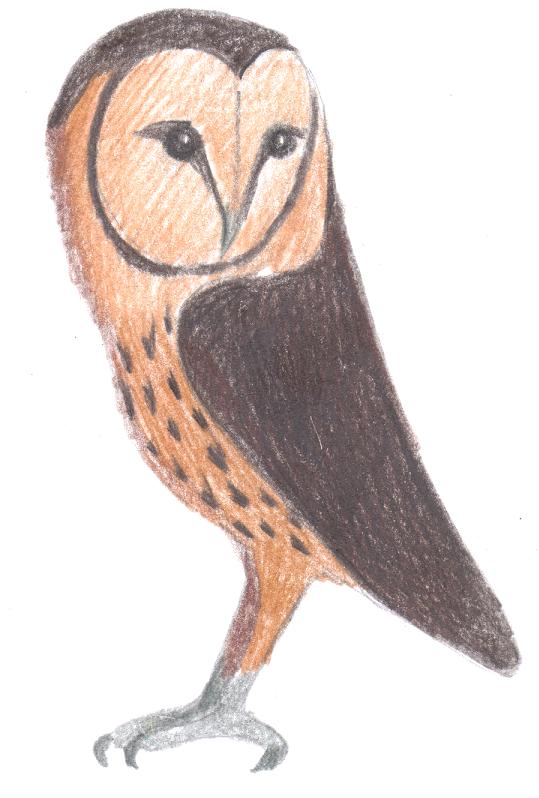
Sula Islands barn owl
Tyto nigrobrunnea Neumann, 1939
Tytonidae; Strigiformes; Aves; Chordata
Colour pencil illustration
February 2010


Tiktaalik roseae Daeschler, Shubin, & Jenkins, 2006
Family and order incertae sedis; Sarcopterygii; Chordata
Colour pencil illustration
February 2010


Cuban solenodon
Solenodon cubanus Peters, 1861
Solenodontidae; Eulipotyphla; Mammalia; Chordata
Colour pencil illustration
February 2010


Brothers Island tuatara
Sphenodon guntheri (Buller, 1877)
Sphenodontidae; Rhynchocephalia; Sauropsida; Chordata
Colour pencil illustration
February 2010

Wednesday, 1 September 2010

PK Comics

Not something I normally blog about, but check out this new web comic, PK Comics, which is just starting out. It was created by a close friend of mine, who has a real talent at this sort of thing. A word about the artistic quality: my friend decided to start uploading the panels as soon as possible in order to get the comic out there. He insists the quality of the artwork will improve in future strips as he takes more time in creating them. The relevance of this comic to me and my interests will become clear in due course...

Monday, 28 June 2010

Prehistoric Animal Alphabet


Prehistoric Animal Alphabet
Colour pencil illustrations
June 2010

Above is a collection of twenty-six illustrations, each a stylised letter of the alphabet. They are styled to look like various prehistoric creatures, some are based loosely on existing types, others completely made up. All of them have been given a binomial, with each name beginning with the letter the animal represents, and a bit of geological/biological 'information' has been made up to go with each animal. To reiterate, none of these animals actually exists or have ever existed, and I cannot guarantee that all the names I have given them are unique and not synonyms (technically these are all nomina nuda, but anyway, enjoy...)


Alpharaptor aetonyx (meaning 'eagle-clawed "A" plunderer) was a purple-feathered theropod from late Cretaceous China. It had large, eagle-like talons on all four limbs and preyed upon small birds and mammals.


Betasaurus beryllinus ('beryl-like "B" lizard) was a medium-sized hadrosaur from late Cretaceous Alberta. It lived in large herds to defend itself from large tyrannosaurs, and fed upon cycads. The B-shaped head enabled Betasaurus to produce a sound somewhat like a euphonium.


Cyanosuchus cadaverinus ('corpse-like blue crocodile', from the colour and odour of the fossil remains) was a mesoeucrocodylian from Early Cretaceous southern England. It was a fish-eater and swam in freshwater lagoons.


Deltaceratops dipsomanius ('alcoholic "D" horned face') was a protoceratopsid from Late Cretaceous Mongolia. It lived in deserts and fed upon whatever ground cover it could find. Its specific epithet 'dipsomanius' was derived from the sprawled position of the type specimen.
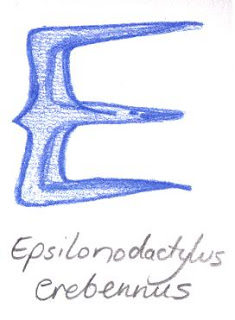


Epsilonodactylus erebennus ('gloomy "E" finger) was a pteranodontid pterosaur from Late Cretaceous Argentina. It was discovered on a particularly gloomy day. It was a fish-eater, being most partial to sharks. It is thus believed to be an oceanic wanderer, like today's albatrosses.


Falcunguis ferox ('ferocious sickle claw') is only known from the claws and phalanges of two digits. It is believed to be an ancestor of the therizinosaurs, due to its geological and geographical distribution in Early Cretaceous China.


Gammasaurus geophagus ('earth eating "G" lizard) was a small coelurosaur with a very long tail which curved backwards over its body. It used the elongated tail to carry leaves which it used to shade itself in hot weather. It dates from the late Jurassic of Bavaria and ate large subterranean insects. Fossilised beetle remains were found in the stomachs of several well-preserved specimens of Gammasaurus geophagus, but these were erroneously believed to be examples of fossilised earth (so basically, rocks).


Hypsiloura helioscopus ('sky gazing high tail') was a camarasaurid from late Jurassic Montana. It was a medium-sized sauropod, capable of reaching tall monkey puzzles in search of foliage and pine cones. It was able to camouflage itself against the trunks of such trees by erecting its neck and tail and pretending to be a tree.


Iotatitan ischyrus ('strong "I" giant) was a titanosaurid from late Cretaceous Argentina. It was the largest sauropod ever known, and it is only known from a single partial cervical vertebra, but its total length has been extrapolated as anywhere from 27 m at the most conservative to 1.3 km at the other extreme. Since nothing is known of the skull or dentition, we cannot say anything about the diet of Iotatitan, except that it definitely ate something, and a lot of it.


Jovigyrinus jocosus ('joking Bon Jovi's salamander') was an early tetrapod from Devonian New Jersey. It was named after local rock band Bon Jovi. Jon Bon Jovi, the lead singer of the band, who is also an unsuccessful actor, has been quoted as saying about the animal, "Wow, at last something in the last two decades I can be proud of!" The animal was probably a predator of small fish and aquatic invertebrates such as trilobites in shallow seas, and would have had external gills like modern salamander larvae and axolotls.


Kappatherodon keiolophus ('cloven-crested "K" mammal-tooth') was a sphenacodontid therapsid related to Dimetrodon, but can be distinguished from it by its cloven back sail. Like its relative, it dates from the Permian of Texas and was a predator of smaller therapsids. It could only be active on hot days, between the hours of 10 and 11 a.m. and 1 and 2 p.m., unless it was during daylight savings time, when the hours are shifted an hour ahead. If Kappatherodon overslept, it would starve and become food for many a hungry Dimetrodon.


Lambdatherium lanatum ('woolly "L" mammal') was a multituberculate mammal from the Late Cretaceous of Kazakhstan. It was a colonial animal, living in mass burrow systems like rabbits or prairie dogs. It managed to survive beyond the K-T boundary, with remains of Lambdatherium lanatum being found 10 million years into the Palaeocene, proving beyond doubt that dinosaurs were abducted by aliens.


Micromacropteryx minutissimus ('very tiny little thing with long wings') was the late Triassic equivalent of a hummingbird. Although there were no flowering plants at the time, individuals could be seen flitting from plant to plant looking for sources of nectar. Of course, because there was no such thing as nectar, Micromacropteryx became hypercarnivorous, eating just about any flesh it could wrap its tiny jaws around.


Neonothosaurus natans ('swimming new bastard lizard', for its unknown parentage, and the fact that it's not very nice) was not a true nothosaur, and was not even a reptile. It represents the only known member of a lineage of lissamphibians to have developed a coat of scales which makes it able to spend extended periods of time outside of water. It lived in early Triassic lakes across northern Pangaea, which was to become the supercontinent of Laurasia.


Omegaraptor ookleptes ('egg-stealing "O" plunderer') was a large turquoise-coloured oviraptoran closely related to Citipati osmolskae. Like that dinosaur, Omegaraptor had a large and brightly-coloured head, and probably didn't steal eggs. That didn't stop one taxonomist from naming the species ookleptes, because he felt that just because it hasn't been proven, doesn't mean it isn't true.


Piceratops psittacoides ('parrot-like "P" horned face') is a close relative of Psittacosaurus but is much larger. Reaching a maximum of 20 m, Piceratops was easily the largest of the ceratopsians, and dwelled in Late Cretaceous forests in China.


Quinquecornis quintilis ('five horns of July') was the smallest of the ceratopsians, with adults reaching no more than 40 cm in length. Most of that length was taken up by the huge frill. As its name suggests, it has five horns: two small jugal horns on each side of the face; and a single large nasal horn. It lived in late Cretaceous North America. Fossils of Q. quintilis are most often discovered in the month of July.


Rhosaurus reductus ('aloof "R" lizard) was a prosauropod from Late Triassic South Africa. Just like the same region nowadays, South Africa was full of noisy buzzing sounds, but instead of coming from plastic vuvuzelas, Rhosaurus would have contributed to the din. It was a plant eater but was believed to be nocturnal due to its large orbits, but this is now known to be where the buzzing sounds arise from. The nocturnal nature led early palaeontologists to believe Rhosaurus was timid and aloof, hence the specific name.
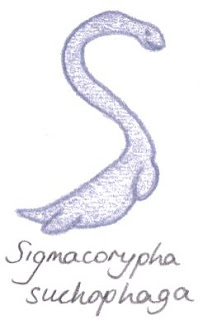


Sigmacorypha suchophaga ('crocodile-eating "S" neck') was an elasmosaur, a group of long-necked plesiosaurs. It was a significant predator of Cyanosuchus, eating several individuals in one sitting.


Tautherium tragocerum ('goat-horned "T" mammal') was an ox-like ungulate from Miocene Tibet, occupying a similar niche to today's yak (Bos grunniens). It had no external ears, because its ancestors were aquatic and had since lost their pinnae.


Upsilonobatrachus umbrivagus ('shade-dwelling "U" frog') was a large temnospondyl amphibian from Carboniferous Spain. It would have preferred to lurk in the shade of tree ferns and other such plants whilst submerged in the water with its jaws agape, waiting for small fish to approach. Its yellow coloration is believed to be the earliest example of aposematic coloration known.


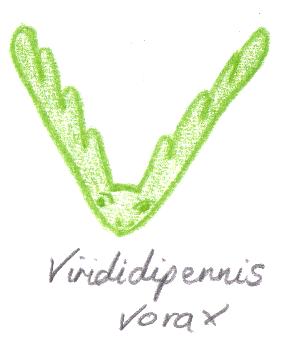
Virididipennis vorax ('with two green feathers and a huge appetite') was a small tree-dwelling reptile related to lizards and snakes but with large scaly outgrowths on the head which resemble feathers. The rest of the body is not known, but it has been suggested that it could be upto several miles long. It dwelled in Pliocene Thailand.


Woganosaurus williamsi ('Robin Williams's and Terry Wogan's lizard') was an early reptile that defies classification. It was found in Scotland in Carboniferous rocks by members of the BBC Radio 2 crew, and was named after the veteran host Terry Wogan. Robin Williams was honoured in the specific epithet due to the taxonomist's fondness for the movie Mrs. Doubtfire.


Xipteryx xanthypothalassus ('Yellow Submarine "X" wing') was an early primate which experimented with gliding. It had a pair of patagia between the ankle and wrist and would glide from tree to tree in Eocene Europe. The type specimen was discovered by Ringo Starr while touring. The species was named after one of his band's most popular songs, and one of the easiest to translate into Ancient Greek.


Yahoolophosaurus yptios ('upside-down Y.A.H.O.O. crested lizard') was a therapsid discovered in Permian Russia. It was found by members of the Young American Historical Ornithological Organisation who were on a field trip to Russia. The first specimen to be exhibited was mounted upside-down, hence the name, and why all reconstructions of the creature are upside-down.


Zetaornis zaocys ('very fast "Z" bird') was a species of tern (family Sternidae) from Pliocene Alaska. It had disproportionally long wings to power its extremely fast flight. It has been suggested that it could have reached speeds of upto 186,000 miles per second, which is of course the speed of light.