
Sunday, 20 March 2011
Panthera leo & Panthera tigris & Tremarctos ornatus...
...oh my! Just got back from Antwerp Zoo in Belgium, the last of three zoos I have been to this week, beginning with Artis in Amsterdam, and followed by Diergarden Blijsdorp in Rotterdam. They've all been amazing, and I have seen many species of animal for the first time. A brief list of critters I've seen at these zoos would include: giant anteater, two-toed sloth, common tree shrew, red ruffed lemur, hamadryas baboon, mandrill, Javan lutung, siamang, eastern lowland gorilla, gundi, rock cavy, capybara, Cuban hutia, North American porcupine, coypu, swift fox, African hunting dog, yellow-throated marten, binturong, margay, serval, Asiatic golden cat, Amur leopard, spectacled bear, polar bear, harbour seal, rock hyrax, Asiatic elephant, Indian rhinoceros, Malayan tapir, Grevy's zebra, lesser Malay chevrotain, sika deer, okapi, wisent, American bison, Egyptian rousette, southern cassowary, Darwin's rhea, macaroni penguin, Atlantic puffin, lapwing, ruff, monk vulture, milky eagle owl, emerald hummingbird, great blue turaco, Asian fairy bluebird, false gharial, slender-snouted crocodile, Japanese giant salamander, greater siren, bamboo cat shark... there are loads more. Unfortunately, I missed out on the sea otters at Rotterdam, and the kiwi and genets at Antwerp. Photos to come at some point, if not here, then on my Facebook group.


Monday, 14 March 2011
Greetings from Amsterdam
I'm currently in the capital of the Netherlands relaxing after a long day of travelling here from London via Brussels. It's taken nearly ten hours, but I'm now in the hotel where I'll be staying for the next three nights. Tomorrow's plan is to visit the zoo in Amsterdam, commonly known as Artis, as well as the natural history museum and botanic gardens in the same area. Although today was mostly spent in transit, I did get a bit of birdwatching done from my seat in the train from Brussels. Below is a list of birds I saw, including a couple of dubious ones that went just that little bit too quickly...
Great crested grebe (Podiceps cristatus)
Grey heron (Ardea cinerea)
Mute swan (Cygnus olor)
Greylag goose (Anser anser)
Canada goose (Branta canadensis)
Egyptian goose (Alopochen aegyptiacus)
Mallard (Anas platyrhynchos)
Wigeon (A. penelope)
Tufted duck (Aythya fuligula)
Hen harrier (Circus cyaneus)
Buzzard (Buteo buteo)
Pheasant (Phasianus colchicus)
Moorhen (Gallinula chloropus)
Coot (Fulica atra)
Lapwing (Vanellus vanellus)
Black-headed gull (Chroicocephalus ridibundus)
Herring gull (Larus argentatus)
Feral pigeon (Columba livia)
Wood pigeon (C. palumbus)
Blackbird (Turdus merula)
Magpie (Pica pica)
Jackdaw (Corvus monedula)
Carrion crow (C. corone)
I'm not sure about the hen harrier, as I say, we were moving at a helluva speed, but I'd like to think it was one. Saw many birds on large water bodies, but without bins and at high speed I had no chance of identifying them as anything other than "bird".
That's all for now, dinner beckons...
Great crested grebe (Podiceps cristatus)
Grey heron (Ardea cinerea)
Mute swan (Cygnus olor)
Greylag goose (Anser anser)
Canada goose (Branta canadensis)
Egyptian goose (Alopochen aegyptiacus)
Mallard (Anas platyrhynchos)
Wigeon (A. penelope)
Tufted duck (Aythya fuligula)
Hen harrier (Circus cyaneus)
Buzzard (Buteo buteo)
Pheasant (Phasianus colchicus)
Moorhen (Gallinula chloropus)
Coot (Fulica atra)
Lapwing (Vanellus vanellus)
Black-headed gull (Chroicocephalus ridibundus)
Herring gull (Larus argentatus)
Feral pigeon (Columba livia)
Wood pigeon (C. palumbus)
Blackbird (Turdus merula)
Magpie (Pica pica)
Jackdaw (Corvus monedula)
Carrion crow (C. corone)
I'm not sure about the hen harrier, as I say, we were moving at a helluva speed, but I'd like to think it was one. Saw many birds on large water bodies, but without bins and at high speed I had no chance of identifying them as anything other than "bird".
That's all for now, dinner beckons...
Friday, 11 March 2011
Some more time perhaps...
Oops, I forgot I was supposed to reveal the answers to the quiz a few days ago... I'll attempt to hide that by giving you another week or so to send your answers in. The new closing date will be 21st March.
Wednesday, 23 February 2011
Guess the skull quiz
It's been a while since I've posted a quiz on this blog (actually, it's been a while since I've posted anything on this blog at all, but hey), so I thought it was time for a sequel to the Cranial Challenge. This time, there are 24 mammals and 24 skulls. Identify each mammal as specifically as you can (you should, if you're skilled enough, be able to identify d to subspecies, i to breed, and the rest to species, with the possible exception of f). Then match each lettered mammal to its numbered skull, i.e. a1 b2 etc. If that seems a little hard for you, not to worry, either have a go anyway, or just play part one of the quiz.


Both photo montages can be enlarged by clicking on them. The skulls match the mammals to species in every example as far as I know. All photographs taken by myself, more details when the answers are revealed.
Send your entries to subhumanfreaks at hotmail dot com by 7th March, when I'll reveal the answers. There may be a prize if I'm impressed enough!


Both photo montages can be enlarged by clicking on them. The skulls match the mammals to species in every example as far as I know. All photographs taken by myself, more details when the answers are revealed.
Send your entries to subhumanfreaks at hotmail dot com by 7th March, when I'll reveal the answers. There may be a prize if I'm impressed enough!
Monday, 24 January 2011
London Wetland Centre gallery
One of my favourite places to get some birdwatching done is the London Wetland Centre. I've put together almost 200 of my best photographs covering pretty much all the birds I've ever seen there, including an awful shot of a bittern I saw this past Saturday. So thanks to everyone at the Centre for the fantastic work they do, and a special thanks to Jamie Wyver who organises the Centre's Facebook Group, tweets on their behalf (@wwtlondon), and gave me a metaphorical hat-tip as to the whereabouts of the bittern.
Sunday, 23 January 2011
Drawing Mega-Mammals
Last month, I spent some time in my beloved Natural History Museum (not mine, of course, but it's mine in the sense that I've spent a rather large chunk of my life within its walls) drawing some of the mammals. I was spurred into it by the need to create new content for the (then) upcoming elephant gallery at ART Evolved.

American Mastodon skeleton
Mammut americanum (Kerr, 1792)
Mammutidae; Proboscidea; Mammalia; Chordata
Line drawing in graphite pencil
Drawn from mounted specimen at Natural History Museum, London, December 2010
I decided to draw the American mastodon because the skeleton was in a convenient place to sit/stand, and it was fairly quiet. Although the mammal halls in the NHM are usually fairly popular, few people go to the 'dead end' that is made up of a woolly mammoth Mammuthus primigenius skull, a Stegodon ganesa skull, and the mastodon skeleton.

American Mastodon in tundra scene
Marker pen on clear acetate, with photo backdrop (by Billy Lindgrom at Wikimedia Commons)
Drawn from mounted specimen at Natural History Museum, London, December 2010
I then thought I'd try something different; I brought along some clear acetate sheets, like those used for overhead projections, and marker pens. After completing the pencil drawing, using that and the actual specimen as a guide, I drew an outline of the mastodon as it would be with all the layers of muscle, fat, and fur, including the boneless fillet that is the trunk. I was somewhat happy with the end result, but thought of superimposing a tundra backdrop afterwards.

Moropus elatus Marsh, 1877
Chalicotheriidae; Perissodactyla; Mammalia; Chordata
Line drawing in graphite pencil
Drawn from mounted specimen at Natural History Museum, London, December 2010
Moropus isn't an elephant, or even a proboscidean, so it didn't end up in the ART Evolved gallery. This is the first place outside my sketchpad that this piece has been seen. Moropus was a chalicothere, a member of odd-shaped herbivorous mammals with relatively long forelimbs and short hindlimbs. They have well-developed claws on all limbs, and possibly used them to pull down leafy branches from up high to feed on. I didn't produce an acetate reconstruction of Moropus, but I might one day.

Paleoparadoxia tabatai Tokunaga, 1939
Paleoparadoxiidae; Desmostylia; Mammalia; Chordata
Line drawing in graphite pencil
Drawn from mounted specimen at Natural History Museum, London, December 2008
As you can see, I did this drawing over 2 years ago, whilst I worked at the library at the NHM. Paleoparadoxia is a member of the order Desmostylia, within the group of orders known as Afrotheria. The Afrotheria consist of six extant (surviving) orders: Proboscidea (elephants); Hyracoidea (hyraxes); Sirenia (manatees and dugongs); Tubulidentata (aardvarks); Afrosoricida (tenrecs and golden moles); and Macroscelidea (sengis, or elephant shrews). There are also a few completely extinct orders, one of which was the Desmostylia.
They mostly lived around the northern Pacific Ocean, with localities mostly in Japan, western Canada and the western United States. Several genera have been named, and although it is believed that all desmostylians were aquatic to some extent, some were more ocean-going than others. The main evidence for such a conclusion is bone density, which reveals just how heavy and able to sink or float the animals were.

Paleoparadoxia tabatai life reconstruction
Graphite pencil illustration
Drawn from mounted specimen (skeleton) at Natural History Museum, London, December 2010
Whilst at the Museum on the day I drew the rest of the specimens, I thought I'd do a life reconstruction of this desmostylian. I'm not very happy with the way the face has turned out, as I don't think I've drawn the teeth accurately at all. In my defence, the specimen on display is quite poor, and a lot of liberties have to be made as to tooth count and position of limbs.

Phiomia serridens Andrews & Beadnell, 1902
Phiomiidae; Proboscidea; Mammalia; Chordata
Graphite pencil illustration Drawn from specimen at Natural History Museum, London, December 2010
And this is the other new piece I submitted to the elephant gallery. Phiomia was a small, early proboscidean with a short trunk. A skull is on display next to a reconstructed model of it. My own reconstruction, therefore, was unnecessary. Also, I only had the skull to work from.
May I take this opportunity to remind you of the official Facebook group, and the first volume of The Disillusioned Taxonomist in print form, covering posts from mid to late 2008.

American Mastodon skeleton
Mammut americanum (Kerr, 1792)
Mammutidae; Proboscidea; Mammalia; Chordata
Line drawing in graphite pencil
Drawn from mounted specimen at Natural History Museum, London, December 2010
I decided to draw the American mastodon because the skeleton was in a convenient place to sit/stand, and it was fairly quiet. Although the mammal halls in the NHM are usually fairly popular, few people go to the 'dead end' that is made up of a woolly mammoth Mammuthus primigenius skull, a Stegodon ganesa skull, and the mastodon skeleton.

American Mastodon in tundra scene
Marker pen on clear acetate, with photo backdrop (by Billy Lindgrom at Wikimedia Commons)
Drawn from mounted specimen at Natural History Museum, London, December 2010
I then thought I'd try something different; I brought along some clear acetate sheets, like those used for overhead projections, and marker pens. After completing the pencil drawing, using that and the actual specimen as a guide, I drew an outline of the mastodon as it would be with all the layers of muscle, fat, and fur, including the boneless fillet that is the trunk. I was somewhat happy with the end result, but thought of superimposing a tundra backdrop afterwards.
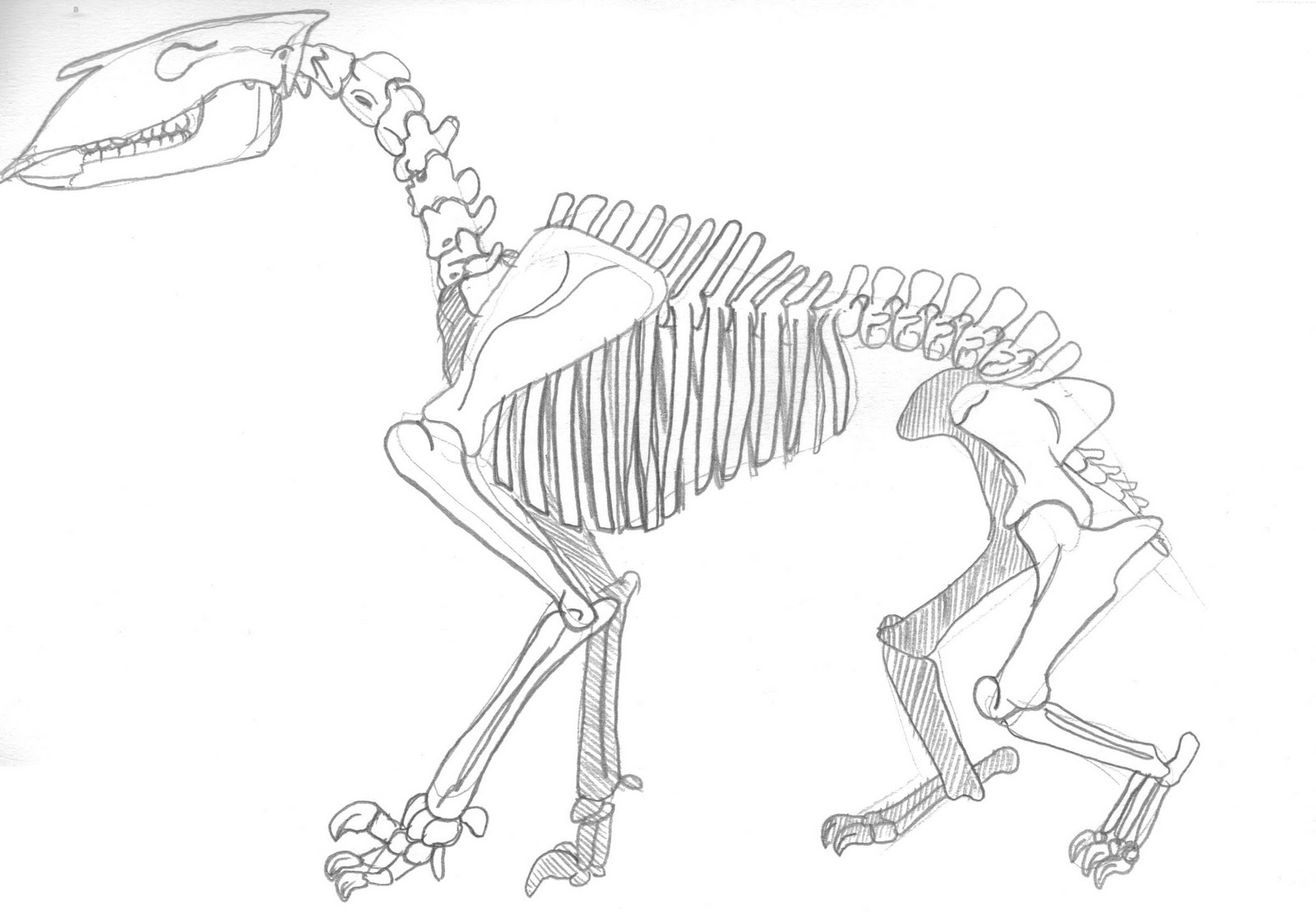
Moropus elatus Marsh, 1877
Chalicotheriidae; Perissodactyla; Mammalia; Chordata
Line drawing in graphite pencil
Drawn from mounted specimen at Natural History Museum, London, December 2010
Moropus isn't an elephant, or even a proboscidean, so it didn't end up in the ART Evolved gallery. This is the first place outside my sketchpad that this piece has been seen. Moropus was a chalicothere, a member of odd-shaped herbivorous mammals with relatively long forelimbs and short hindlimbs. They have well-developed claws on all limbs, and possibly used them to pull down leafy branches from up high to feed on. I didn't produce an acetate reconstruction of Moropus, but I might one day.

Paleoparadoxia tabatai Tokunaga, 1939
Paleoparadoxiidae; Desmostylia; Mammalia; Chordata
Line drawing in graphite pencil
Drawn from mounted specimen at Natural History Museum, London, December 2008
As you can see, I did this drawing over 2 years ago, whilst I worked at the library at the NHM. Paleoparadoxia is a member of the order Desmostylia, within the group of orders known as Afrotheria. The Afrotheria consist of six extant (surviving) orders: Proboscidea (elephants); Hyracoidea (hyraxes); Sirenia (manatees and dugongs); Tubulidentata (aardvarks); Afrosoricida (tenrecs and golden moles); and Macroscelidea (sengis, or elephant shrews). There are also a few completely extinct orders, one of which was the Desmostylia.
They mostly lived around the northern Pacific Ocean, with localities mostly in Japan, western Canada and the western United States. Several genera have been named, and although it is believed that all desmostylians were aquatic to some extent, some were more ocean-going than others. The main evidence for such a conclusion is bone density, which reveals just how heavy and able to sink or float the animals were.

Paleoparadoxia tabatai life reconstruction
Graphite pencil illustration
Drawn from mounted specimen (skeleton) at Natural History Museum, London, December 2010
Whilst at the Museum on the day I drew the rest of the specimens, I thought I'd do a life reconstruction of this desmostylian. I'm not very happy with the way the face has turned out, as I don't think I've drawn the teeth accurately at all. In my defence, the specimen on display is quite poor, and a lot of liberties have to be made as to tooth count and position of limbs.

Phiomia serridens Andrews & Beadnell, 1902
Phiomiidae; Proboscidea; Mammalia; Chordata
Graphite pencil illustration Drawn from specimen at Natural History Museum, London, December 2010
And this is the other new piece I submitted to the elephant gallery. Phiomia was a small, early proboscidean with a short trunk. A skull is on display next to a reconstructed model of it. My own reconstruction, therefore, was unnecessary. Also, I only had the skull to work from.
May I take this opportunity to remind you of the official Facebook group, and the first volume of The Disillusioned Taxonomist in print form, covering posts from mid to late 2008.
Thursday, 30 December 2010
So long 2010...
...and greetings to MMXI. I’m writing this post on the penultimate day of the year, whilst I take a brief hiatus from the etymological research which has eaten up a lot of my time to retrospect about the year that was (and still is, for another 26 and a bit hours here in London) 2010.
It’s been a year of ups and downs for me. It has included a trip to Paris, a symposium in Cambridge, and a crippling depression. I made some new friends, got in touch with a few old ones, and lost family members.
As it currently is, I haven’t got an awful lot to complain about, and I feel thankful for all the good that’s happened to me so far, despite 2010 being punctuated with several events that could have ended very badly. I really didn’t think I’d make it through this year, and, as those who have been affected by those events will know, is no hyperbole.
I had my first taste of a proper relationship, and although it took me several months to get over, I am feeling much better for having had the experience, despite the suffering that came with it. I came out as gay this year, which was probably the single most liberating thing I have ever done. I feared a backlash, with some people declaring they weren’t comfortable with this, but so far nobody has reacted negatively. The metaphorical closet was lonely and claustrophobic, and I had to get out of there. I don’t regret the decision one iota.
I was employed for three months at Bruce Castle Museum, a spell which was ended prematurely due to the seriousness of the depression I was going through at the time. In the months since, I have slowly been getting better to the point where I now feel able to work again, and have been putting so much effort into the research for the etymological dictionary which I’m aiming to get published in 2011. I also resolve to take better care of my health (an oft-made resolution, but one which I really have to take seriously), and to get out there and make more friends in the New Year. Oh, and I must restart on some fiction projects I had started this year when my head was in an odd place.
My deepest thanks go to my friends and family who have helped support me during this oddest of years, to my online following who have boosted this tiny, yet no less shallow, ego, and to the wonder that is antidepressant medication. Here’s to a merry 2011!
It’s been a year of ups and downs for me. It has included a trip to Paris, a symposium in Cambridge, and a crippling depression. I made some new friends, got in touch with a few old ones, and lost family members.
As it currently is, I haven’t got an awful lot to complain about, and I feel thankful for all the good that’s happened to me so far, despite 2010 being punctuated with several events that could have ended very badly. I really didn’t think I’d make it through this year, and, as those who have been affected by those events will know, is no hyperbole.
I had my first taste of a proper relationship, and although it took me several months to get over, I am feeling much better for having had the experience, despite the suffering that came with it. I came out as gay this year, which was probably the single most liberating thing I have ever done. I feared a backlash, with some people declaring they weren’t comfortable with this, but so far nobody has reacted negatively. The metaphorical closet was lonely and claustrophobic, and I had to get out of there. I don’t regret the decision one iota.
I was employed for three months at Bruce Castle Museum, a spell which was ended prematurely due to the seriousness of the depression I was going through at the time. In the months since, I have slowly been getting better to the point where I now feel able to work again, and have been putting so much effort into the research for the etymological dictionary which I’m aiming to get published in 2011. I also resolve to take better care of my health (an oft-made resolution, but one which I really have to take seriously), and to get out there and make more friends in the New Year. Oh, and I must restart on some fiction projects I had started this year when my head was in an odd place.
My deepest thanks go to my friends and family who have helped support me during this oddest of years, to my online following who have boosted this tiny, yet no less shallow, ego, and to the wonder that is antidepressant medication. Here’s to a merry 2011!
Saturday, 25 December 2010
200th post announcement
So, it’s Christmas evening and I’m suitably overfed and groggy, but I thought I’d give all my readers the news I promised I’d deliver. For this post, my 200th on The Disillusioned Taxonomist, is the public announcement of both the official Facebook group of this blog, and also the first volume of the blog in book form!!

The first eight months of The Disillusioned Taxonomist are now available to purchase from Lulu with full colour artwork and photography for the reasonable price of £23.99. If you’ve been following my blog since the beginning or thereabouts (way back in May 2008), you will most likely have fond but distant memories of Meeting with a Spinosaurus, illustrations of all the penguins of the world, biographies of my three cats, and a bizarre Cypriot museum. Of course, you could read all of these for free by checking the archives, but there are a few additional entries that might just make it worthwhile to buy!
You may be wondering why I waited until after Christmas to make this announcement, well, I simply didn’t come up with the idea until very recently. I won’t deny I have partially been influenced to publish a blook (not sure if this is a neologism, but I want credit if it is and makes it into the OED, please) by seeing Darren Naish’s first volume of Tetrapod Zoology.

The first eight months of The Disillusioned Taxonomist are now available to purchase from Lulu with full colour artwork and photography for the reasonable price of £23.99. If you’ve been following my blog since the beginning or thereabouts (way back in May 2008), you will most likely have fond but distant memories of Meeting with a Spinosaurus, illustrations of all the penguins of the world, biographies of my three cats, and a bizarre Cypriot museum. Of course, you could read all of these for free by checking the archives, but there are a few additional entries that might just make it worthwhile to buy!
You may be wondering why I waited until after Christmas to make this announcement, well, I simply didn’t come up with the idea until very recently. I won’t deny I have partially been influenced to publish a blook (not sure if this is a neologism, but I want credit if it is and makes it into the OED, please) by seeing Darren Naish’s first volume of Tetrapod Zoology.
Wednesday, 22 December 2010
Happy Holidays!

Happy Holidays to all The Disillusioned Taxonomist readers!
Special announcement for 200th post... you'll have to wait till after Crimbo, I'm afraid!!
Thursday, 9 December 2010
Interview with Brian Switek
Here follows an interview with Brian Switek, author of Written in Stone, the blogs Laelaps and Dinosaur Tracking, and several popular and academic articles.
Can you describe your sense of pride upon having a book and several articles published? Can you compare it to anything?
That's actually a tricky one to answer. There was no single, satisfying moment when I laid down the book manuscript, heaved a sigh, and said "It is finished" with a smile on my face. Quite the opposite. When I send off the last of the edits for the book my first thought was "Shit, what am I going to do now?"
Freelancing is tough. During the work week I spend most of any given day at an office job unrelated to my interests and I squeeze in whatever writing I can when I get home. As soon as I finish one essay or story I immediately start thinking of what I am going to do next and where I am going to pitch it. I have been successful with writing and I am proud of having written a book, but, since there has not been any change to my day-to-day life, I can't say that I feel any different. I'm still in "sink or swim" mode. There are simply too many things to write!
Nevertheless, the response to Written in Stone has been wonderful. Its publication made me anxious initially - I had no idea how it would be received - but I have not seen a bad review yet. I am thrilled that so many readers, with so many different backgrounds, have enjoyed the book.
With respect to the recent debate that took place on the Dinosaur Mailing List, how much importance do you think using the correct words is in forming scientific names, for example, using correct spellings of foreign words? Are you of the opinion that ignorance of such subjects sets a poor example to future generations, despite it being negligible to the actual science involved? Is there a difference between "dead" languages such as Latin, and those which are more alien to the western ear, such as Chinese?
If you are going to name a new species, you had best do it right. Regardless of whether that name has Latin roots or is being derived from another language, I think scientists have a responsibility to check and double check that the name is spelled correctly and otherwise linguistically accurate. Does a bad or misspelled name significantly hurt paleontology? I don't think so - the bones don't change even the name used to categorize them does - but making sure that words are being used correctly is just part of good science. For my own part, though, misspelled names don't bother me at all. If the recognized name for a species is misspelled, there is nothing I can do about it.
Without wanting to create some sort of patriotic rivalry, in your opinion, which country's scientists have done more for the sake of furthering the human understanding of the prehistoric world, Britain or America?
I am not going to be happy with either choice - scientists and naturalists from both countries have contributed greatly to our understanding of the history of life - but, if I must choose, I think I have to say the United States. Specifically, your question makes me think of the rapid development of American paleontology during the late 19th century when E.D. Cope and O.C. Marsh (plus their various students, assistants, and field crews) dug into the west and found creatures unlike any seen anywhere before. The creatures they were discovering were not only unique, but were also scrutinized in regard to what they could tell us about evolution - the toothed birds (Ichthyornis, Hesperornis) and multi-toed horses Marsh found, in particular, thrilled British evolutionists like Charles Darwin and Thomas Henry Huxley. And, perhaps more importantly, the opening of the American west showed that the strata of Europe could not be taken as a near-complete proxy for the fossil record elsewhere. There was much left to discover elsewhere.
After the "Bone Wars" era, paleontology became more formally ensconced in American universities and museums. True, many expeditions were sent to find the biggest and best dinosaur skeletons, but many paleontologists (Elmer Riggs, W.B. Scott, William Diller Matthew, etc.) were very interested in what fossil mammals could tell us about evolutionary change. Granted, paleontology did go through a lull during the mid-20th century, but by the 1970's the field was reinvigorated by researchers like Tom Schopf, Stephen Jay Gould, Niles Eldredge, Steven Stanley, David Raup, Jack Sepkoski, and others who turned the science into an interdisciplinary pursuit of extreme importance to evolutionary questions. This "Paleobiological Revolution" continues today, although given the exchange of scientists and ideas between countries I don't think of things in a delineated pattern of strictly American and British paleontology traditions.
As I said, I am not very happy having to pick sides, but I think the spectacular geology of North America helped paleontology take off once it became established in the United States. It is a bit of historical contingency which allowed the science to flourish here.
We know that DNA and other molecules have become important in recent decades in revolutionising our view of true phylogenies in living taxa, but how much of a role can such data seriously play in interpreting fossil groups? In your opinion, as technology improves, will molecular data become a significant part of palaeontological practice, or will we [hopefully!] revert to a more classic, anatomically-based study? [You can tell what I think; this is why I called my blog 'The Disillusioned Taxonomist' after all!]
Obviously molecular phylogenies are extremely limited in their ability to tell us about fossil groups. If a lineage is entirely extinct - and there are many, many such lineages - they molecular phylogenies cannot take them into account. Take the now-resolved debate over the origin of whales, for example. During the 1980's and 1990's paleontologists preferred mesonychids (hoofed, predatory mammals) as whale ancestors on the basis of their teeth but geneticists and molecular biologists kept finding that whales grouped close to hippos and often within the artiodactyl family tree. Both groups were using different data sets, and molecular biologists could not include mesonychids because they became extinct long ago. What the molecular phylogenies did was - using data from modern mammals - make a prediction about what might be expected. Eventually the fossil data confirmed that whales are highly-specialized artiodactyls, but the debate over the placement of the mesonychids highlights the difficulty involved in determining evolutionary relationships when (most) extinct taxa are out of the reach of molecular biologists.
But, as the debate over whale origins showed, I think an interdisciplinary approach can be useful to paleontologists. After all, any phylogeny is a hypothesis that is bound to shift as we learn more. (I can't even count all the phylogenies of theropod dinosaurs there have been...) Phylogenies are definitively provisional, and I think that molecular phylogenies can sometimes be useful in making predictions about relationships that can then be tested with data from the fossil record. If the origin of a particular group is unknown, for example, but a molecular phylogeny shows that two lineages are close together and shared a common ancestor, then paleontologists can examine the fossil evidence to see whether or not this relationship holds up. I don't really think about this debate in terms of which method is superior or inferior. Molecular phylogenies and anatomically-based phylogenies can be used as tools that test and complement each other, so I think a combined approach may continue to be fruitful (even if it initially creates more discord than agreement).
Thanks to Brian Switek for answering my questions, now go and read his book!
Can you describe your sense of pride upon having a book and several articles published? Can you compare it to anything?
That's actually a tricky one to answer. There was no single, satisfying moment when I laid down the book manuscript, heaved a sigh, and said "It is finished" with a smile on my face. Quite the opposite. When I send off the last of the edits for the book my first thought was "Shit, what am I going to do now?"
Freelancing is tough. During the work week I spend most of any given day at an office job unrelated to my interests and I squeeze in whatever writing I can when I get home. As soon as I finish one essay or story I immediately start thinking of what I am going to do next and where I am going to pitch it. I have been successful with writing and I am proud of having written a book, but, since there has not been any change to my day-to-day life, I can't say that I feel any different. I'm still in "sink or swim" mode. There are simply too many things to write!
Nevertheless, the response to Written in Stone has been wonderful. Its publication made me anxious initially - I had no idea how it would be received - but I have not seen a bad review yet. I am thrilled that so many readers, with so many different backgrounds, have enjoyed the book.
With respect to the recent debate that took place on the Dinosaur Mailing List, how much importance do you think using the correct words is in forming scientific names, for example, using correct spellings of foreign words? Are you of the opinion that ignorance of such subjects sets a poor example to future generations, despite it being negligible to the actual science involved? Is there a difference between "dead" languages such as Latin, and those which are more alien to the western ear, such as Chinese?
If you are going to name a new species, you had best do it right. Regardless of whether that name has Latin roots or is being derived from another language, I think scientists have a responsibility to check and double check that the name is spelled correctly and otherwise linguistically accurate. Does a bad or misspelled name significantly hurt paleontology? I don't think so - the bones don't change even the name used to categorize them does - but making sure that words are being used correctly is just part of good science. For my own part, though, misspelled names don't bother me at all. If the recognized name for a species is misspelled, there is nothing I can do about it.
Without wanting to create some sort of patriotic rivalry, in your opinion, which country's scientists have done more for the sake of furthering the human understanding of the prehistoric world, Britain or America?
I am not going to be happy with either choice - scientists and naturalists from both countries have contributed greatly to our understanding of the history of life - but, if I must choose, I think I have to say the United States. Specifically, your question makes me think of the rapid development of American paleontology during the late 19th century when E.D. Cope and O.C. Marsh (plus their various students, assistants, and field crews) dug into the west and found creatures unlike any seen anywhere before. The creatures they were discovering were not only unique, but were also scrutinized in regard to what they could tell us about evolution - the toothed birds (Ichthyornis, Hesperornis) and multi-toed horses Marsh found, in particular, thrilled British evolutionists like Charles Darwin and Thomas Henry Huxley. And, perhaps more importantly, the opening of the American west showed that the strata of Europe could not be taken as a near-complete proxy for the fossil record elsewhere. There was much left to discover elsewhere.
After the "Bone Wars" era, paleontology became more formally ensconced in American universities and museums. True, many expeditions were sent to find the biggest and best dinosaur skeletons, but many paleontologists (Elmer Riggs, W.B. Scott, William Diller Matthew, etc.) were very interested in what fossil mammals could tell us about evolutionary change. Granted, paleontology did go through a lull during the mid-20th century, but by the 1970's the field was reinvigorated by researchers like Tom Schopf, Stephen Jay Gould, Niles Eldredge, Steven Stanley, David Raup, Jack Sepkoski, and others who turned the science into an interdisciplinary pursuit of extreme importance to evolutionary questions. This "Paleobiological Revolution" continues today, although given the exchange of scientists and ideas between countries I don't think of things in a delineated pattern of strictly American and British paleontology traditions.
As I said, I am not very happy having to pick sides, but I think the spectacular geology of North America helped paleontology take off once it became established in the United States. It is a bit of historical contingency which allowed the science to flourish here.
We know that DNA and other molecules have become important in recent decades in revolutionising our view of true phylogenies in living taxa, but how much of a role can such data seriously play in interpreting fossil groups? In your opinion, as technology improves, will molecular data become a significant part of palaeontological practice, or will we [hopefully!] revert to a more classic, anatomically-based study? [You can tell what I think; this is why I called my blog 'The Disillusioned Taxonomist' after all!]
Obviously molecular phylogenies are extremely limited in their ability to tell us about fossil groups. If a lineage is entirely extinct - and there are many, many such lineages - they molecular phylogenies cannot take them into account. Take the now-resolved debate over the origin of whales, for example. During the 1980's and 1990's paleontologists preferred mesonychids (hoofed, predatory mammals) as whale ancestors on the basis of their teeth but geneticists and molecular biologists kept finding that whales grouped close to hippos and often within the artiodactyl family tree. Both groups were using different data sets, and molecular biologists could not include mesonychids because they became extinct long ago. What the molecular phylogenies did was - using data from modern mammals - make a prediction about what might be expected. Eventually the fossil data confirmed that whales are highly-specialized artiodactyls, but the debate over the placement of the mesonychids highlights the difficulty involved in determining evolutionary relationships when (most) extinct taxa are out of the reach of molecular biologists.
But, as the debate over whale origins showed, I think an interdisciplinary approach can be useful to paleontologists. After all, any phylogeny is a hypothesis that is bound to shift as we learn more. (I can't even count all the phylogenies of theropod dinosaurs there have been...) Phylogenies are definitively provisional, and I think that molecular phylogenies can sometimes be useful in making predictions about relationships that can then be tested with data from the fossil record. If the origin of a particular group is unknown, for example, but a molecular phylogeny shows that two lineages are close together and shared a common ancestor, then paleontologists can examine the fossil evidence to see whether or not this relationship holds up. I don't really think about this debate in terms of which method is superior or inferior. Molecular phylogenies and anatomically-based phylogenies can be used as tools that test and complement each other, so I think a combined approach may continue to be fruitful (even if it initially creates more discord than agreement).
Thanks to Brian Switek for answering my questions, now go and read his book!
Subscribe to:
Posts (Atom)
