Thursday, 14 April 2011

Oddities from Rotterdam Zoo

Rotterdam Zoo, or to give it its proper name, Diergaarde Blijdorp, is by far the largest of the three zoos I visited on my recent jaunt to the Netherlands and Belgium. So large in fact that I couldn't see it all before closing time. OK, so that could be partly due to the rain and the fact that I took several rest stops, but still, it's immense, on the scale of San Diego Zoo almost. And it's still growing, apparently.

The zoo is relatively new, having built up bit by bit since the 1930s. It now has an impressive Oceanium, containing themed exhibits such as Bass Rock (see below), Atlantic Ocean, the Caribbean, the Falklands, and the Sea of Cortez, containing not just aquatic creatures but also birds, mammals, and reptiles. There are themed areas on the Arctic, with polar bear, arctic fox, and steppe lemming, and South America, with vicuna, Darwin's rhea, and scarlet ibis, before reaching the African and Asian sections, which are both massive. There is a small European section which I didn't get to see, and some wallabies which apparently constitutes an Australasian section. Finally, there is the Rivierahal containing most of the zoo's reptiles and amphibians, fishes, a tropical plant greenhouse with free-flying birds, and the indoor enclosures for the large ungulates like giraffes and hippos.


Atlantic puffin (in winter plumage)
Fratercula arctica (Linnaeus, 1758)
Alcidae; Charadriiformes; Aves; Chordata
Rotterdam Zoo, March 2011 (and all other photographs in this post)

The Bass Rock exhibit is the first in the Oceanium after you pass the California sea lions at the zoo entrance. It consists of a tank containing, appropriately, sea bass (Dicentrarchus labrax), and simulated cliffs for the four bird species, common guillemot (Uria aalge), razorbill (Alca torda - although I didn't see any), black-legged kittiwake (Rissa tridactyla), and of course, Atlantic puffin. These are some of the more prominent species seen at the real Bass Rock off the coast of Scotland, which is an important breeding colony for these and countless other sea birds. Gannets (Morus bassanus) are probably the most famous inhabitants of Bass Rock, the place even being honoured in their specific name by Linnaeus. The puffins at Rotterdam didn't look as clean and brightly-coloured as those you see in photographs, but that's because they're in winter plumage, which is grey where the white is on the face, and the brightly-coloured beak plates are shed after breeding. Never mind, it was nice to finally see these iconic birds in the flesh, and I'll hopefully get to see them in a more natural setting next month when I go to the Farne Islands off the coast of Lincolnshire in the east of England, which is home to puffins and other auks, terns, waders, and gulls.


Cuban, or Desmarest's, hutia
Capromys pilorides Say, 1822
Capromyidae; Rodentia; Mammalia; Chordata

These zoos love their unusual rodents, don't they? Hutias are an exclusively Caribbean group of fairly large rodents, with many members becoming extinct in historic times. The Cuban hutia is still common on its native island, especially in mangrove swamps. In Rotterdam Zoo, there are two hutias of different colours, one very pale one, seen above, and the other a darker shade of brown. They were in the Caribbean section of the Oceanium, with a variety of Caribbean fishes, Toco toucans, and Cuban boas completing the themed area.


Swift fox
Vulpes velox (Say, 1823)
Canidae; Carnivora; Mammalia; Chordata

I got excellent views of a pair of swift foxes, living in the Sea of Cortez exhibit within the Oceanium. The fox is smaller than the red fox but quite large for a desert fox, being found in parts of southern Canada throughout the prairies of the US south towards the border with Mexico, so it isn't really from the Sea of Cortez. That would be the kit fox (V. macrotis), its close relative. They are reminiscent of the corsac foxes (V. corsac) of central Asia that I've seen in captivity fairly often.


Asiatic golden cat
Pardofelis temmincki (Vigors & Horsfield, 1827)
Felidae; Carnivora; Mammalia; Chordata

I'd been waiting for aeons to see this species, and I got fantastic views at Rotterdam in the Asian section of the zoo. Although technically a 'small cat', it's certainly not small, being at least lynx-sized, but not quite as big as a puma. It is one of the most beautifully patterned of cats, with an overall golden tone which has silvery-grey patches in parts, and a subtle spotting which is often completely absent, but sometimes quite bold. The face, as you can see, is wonderfully patterned in stripes. The tail is long and tipped with white on the underside. They are distributed in southeast Asia from Sumatra and the Malay Peninsula north to southern China and the Himalayan foothills. On Borneo, a closely related species, the bay cat (P. badia), is found, which is extremely rare and very rarely seen.


Chinese giant salamander
Andrias davidianus (Blanchard, 1871)
Cryptobranchidae; Caudata; Amphibia; Chordata

It's a giant salamander. The biggest amphibian currently alive today, in fact. It's very rarely seen outside of China, although there are a few in zoos in the States, but none in the UK. As a salamander fan, I was thrilled to see this guy in the flesh. It just looked rather apathetic to see me, however. An extinct close relative, Andrias scheuchzeri, was once identified as the remains of humans living before the Biblical Great Flood. It was hastily re-examined and identified as an amphibian. Thank goodness for that.


Klipspringer
Oreotragus oreotragus (Zimmerman, 1783)
Bovidae; Cetartiodactyla; Mammalia; Chordata

Meaning 'rock jumper' in Dutch and Afrikaans, the klipspringer is an extraordinary antelope. Not just for its cute-as-a-button eyes with adorable thick eyeliner and white eye shadow, or even its horns-but-not-quite-horns. No, even better than that, if you look closely at its hooves, you'll notice that the klipspringer walks on the tips of its hooves, like a ballerina. Even more impressively, it manages to do this on steep, practically vertical rock faces. Klipspringers are widespread in eastern and southern Africa, but live mostly on the kopjes, large granite rock formations. They subsist on rock foliage like crassulaceans (house leeks, or money plants), obtaining all their required moisture from their succulent leaves. They are housed in a large indoor enclosure in the African section of Rotterdam Zoo, sharing their kopje-like enclosure with a group of rock hyraxes (Procavia capensis), and giant tortoises, most likely Aldabra giant tortoises (Dipsochelys dussumieri), but I didn't stop to check. We were so pressed for time at that point, not to mention a couple were getting married and having photos taken in the kopje house, so I felt in the way a bit.


Slender-snouted crocodile
Mecistops cataphractus (Cuvier, 1825)
Crocodylidae; Crocodilia; Sauropsida; Chordata

The least known of the three African crocodiles, the other two being the Nile crocodile (Crocodylus niloticus - also found at Rotterdam Zoo, next door to this guy), and the dwarf crocodile (Osteolaemus tetraspis), the slender-snouted crocodiles at this zoo are the oldest of all their animals. When the zoo was located in the centre of Rotterdam by the railway sidings in the 19th and early 20th centuries, the slender-snouts were hatchlings, probably imported from the French or Belgian African colonies (I'm currently reading Heart of Darkness, thus that kind of stuff is on my mind). The zoo relocated to its current location in Blijdorp in the 1930s, and they have survived since then. This beast was huge, larger and fatter than the false gavials I saw at Artis. Slender-snouted crocodiles live in the same habitat as their larger and smaller cousins, in western and central Africa, but can co-exist due to a difference in diet. While the Nile crocodile will take larger prey (including large ungulates, as anyone who watches wildlife documentaries knows), and the dwarf croc eats small fish and crustaceans, the slender-snout will take those prey items of intermediate size. It is also able to use its snout in a different way to the broad-snouted crocodiles, in that being more slender allows the snout to enter smaller nooks on river beds and such.

Antwerp Zoo coming up soon.

Tuesday, 12 April 2011

Crocodile Lizard, and more...


Chinese crocodile lizard
Shinisaurus crocodilurus (Ahl, 1930)
Shinisauridae; Squamata; Sauropsida; Chordata
Artis Zoo, Amsterdam
March 2011

So, yes, that hyper-macro shot in the previous post was of the Chinese crocodile lizard. It's rare in zoos and almost as rare in the wild. The derivation of its name is obvious; it's from China and looks like a crocodile. As such, it's in its own family within the lizard and snake order Squamata, and its closest relatives within that group aren't known.

Here follow some other interesting and rarely seen mammals and reptiles, all photographed at Artis Zoo.


False gavial (or gharial)
Tomistoma schlegelii Muller, 1838
Gavialidae; Crocodilia; Sauropsida; Chordata

There were two false gavials in their indoor enclosure, one relatively small and slender, and the other, pictured above, who was huge. Never underestimate the apparent sluggishness of a crocodilian at rest; they can leap up without warning, as I discovered that day. If I hadn't been behind the extra barrier, which I wanted to jump over to get better photos, I might have been a goner. I can truly appreciate the terror that such a dangerous animal makes people feel.


White-bellied lizard (female)
Darevskia unisexualis (Darevsky, 1966)
Lacertidae; Squamata; Sauropsida; Chordata

I know this critter is a female not because of any distinctive markings, or a size difference, or obvious genitalia, but because there are no males. Not all animals have to mate to produce offspring. There are a few lizard species that are able to reproduce asexually, with the resultant offspring being exact genetic clones of their mother. As such, they are all female, all each other's sisters and their own mothers... I'm confused too. Anyhow, parthenogenesis (from the Ancient Greek, meaning 'virgin birth') is now being found in many species of reptile, and may be a viable form of reproduction when no males are present.


Spectacled bear
Tremarctos ornatus (Cuvier, 1825)
Ursidae; Carnivora; Mammalia; Chordata

The spectacled bear is the only surviving member of the short-faced bear lineage (Tremarctinae), which were found in North and South America. The short-faced bear itself, Arctodus simus, was a huge, long-legged beast capable of running after its prey. The closest thing we have to it today is the spectacled bear, a mostly herbivorous mammal from the cloud forests of South America. I'd been waiting to see this species for years, and have finally seen all the world's eight living bear species in zoos.


Round-eared elephant shrew (or sengi)
Macroscelides proboscideus (Shaw, 1800)
Macroscelididae; Macroscelidea; Mammalia; Chordata

Elephant shrews, or sengis, are an exclusively African group of mammals in the group Afrotheria, which also contains the outwardly dissimilar aardvark, tenrecs, golden moles, manatees, hyraxes, and elephants. The round-eared elephant shrew from South Africa is one of the smaller members of the group, being similar in size to a small mouse.


Yellow-throated marten
Martes flavigula (Boddaert, 1785)
Mustelidae; Carnivora; Mammalia; Chordata

This beautiful creature comes from Asia, from the cold forests of southern Russia and the Himalayas to the tropical rainforests of Malaysia and Borneo. It is vividly coloured in shades of brown from near black through to yellow and white. It is the largest of the eight marten species distributed throughout the northern Hemisphere, with the pine marten (M. martes) being the most well known in the UK, and the fisher (M. pennanti) and American marten (M. americana) being the two New World species.


Rock cavy, or moco
Kerodon rupestris Wied-Neuwied, 1820
Caviidae; Rodentia; Mammalia; Chordata

Cavies are also known as guinea pigs, the species Cavia porcellus being the one kept as pets and laboratory subjects the world over. There are a number of other species, the largest being the Patagonian mara (Dolichotis patagonum). The rock cavy, however, is rarely seen in captivity. It's found only in Brazil, and are adept climbers, scaling near vertical walls like the ecologically similar rock hyrax (Procavia capensis). According to Wikipedia, they have been recorded displaying homosexual behaviour. 


Common gundi
Ctenodactylus gundi (Rothmann, 1776)
Ctenodactylidae; Rodentia; Mammalia; Chordata

Another rodent oddity, the gundis are a North African family from the dunes and mountains of the Sahara Desert. They have unusual external ears, having almost no pinna (flap). The generic name Ctenodactylus means 'comb finger', as the gundi has comb-like claws which it uses for grooming.


Coypu (or nutria)
Myocastor coypus (Molina, 1782)
Myocastoridae; Rodentia; Mammalia; Chordata

Despite looking somewhat like a beaver, the coypu (called the nutria in North America, from the Spanish word for otter) is more closely related to cavies and chinchillas, and is thus placed in the Caviomorpha with them. It differs externally from the beaver by having a slender, unflattened tail, and thick orange enamel on the front teeth. Originally from South America, they have been reared in captivity for their cheap yet luxuriant fur, and have escaped numerous times, forming feral populations in East Anglia (now presumed extinct), other parts of Europe, in swampy parts of North America, as well as parts of east Africa. Like a giant rat, they are considered pests, as they destroy crops, but are relatively free from disease.

Tuesday, 29 March 2011

What on Earth?


So, what on Earth is that? A couple of (poor) clues: it's not an extant crocodilian; it was photographed two weeks ago at Artis Zoo in Amsterdam (so it's not likely to be a Deinosuchus or something). Answers as comments or to the usual email address.

Saturday, 26 March 2011

Finally, some answers


Answers:
a) African hunting dog (Lycaon pictus) - skull #14
b) grey wolf (Canis lupus) - skull #3
c) cheetah (Acinonyx jubatus) - skull #8
d) Amur tiger (Panthera tigris altaica) - skull #16
e) aardwolf (Proteles cristatus) - skull #7
f) South American sea lion (Otaria flavescens) - skull #5
g) white-nosed coati (Nasua narica) - skull #24
h) binturong (Arctictis binturong) - skull #22
i) Soay sheep (Ovis aries) - skull #17
j) guanaco (Lama guanicoe) - skull #20
k) Chinese water deer (Hydropotes inermis) - skull #10
l) Reeves' muntjac (Muntiacus reevesii) - skull #2
m) white-lipped peccary (Tayassu pecari) - skull #11
n) western hedgehog (Erinaceus europaeus) - skull #13
o) European rabbit (Oryctolagus cuniculus) - skull #18
p) donkey (Equus asinus) - skull #4
q) Indian rhinoceros (Rhinoceros unicornis) - skull #9
r) okapi (Okapia johnstoni) - skull #6
s) aye-aye (Daubentonia madagascariensis) - skull #1
t) white-crested gibbon (Nomascus leucogenys) - skull #23
u) Patagonian mara (Dolichotis patagonum) - skull #12
v) aardvark (Orycteropus afer) - skull #21
w) yellow armadillo (Euphractus sexcinctus) - skull #19
x) giant anteater (Myrmecophaga tridactyla) - skull #15

The winning entry was by Andrea J., so congratulations! No-one got them all right though, if you did but didn't enter, well done but shame on you. New puzzle coming shortly... um, eventually!

Sunday, 20 March 2011

Panthera leo & Panthera tigris & Tremarctos ornatus...

...oh my! Just got back from Antwerp Zoo in Belgium, the last of three zoos I have been to this week, beginning with Artis in Amsterdam, and followed by Diergarden Blijsdorp in Rotterdam. They've all been amazing, and I have seen many species of animal for the first time. A brief list of critters I've seen at these zoos would include: giant anteater, two-toed sloth, common tree shrew, red ruffed lemur, hamadryas baboon, mandrill, Javan lutung, siamang, eastern lowland gorilla, gundi, rock cavy, capybara, Cuban hutia, North American porcupine, coypu, swift fox, African hunting dog, yellow-throated marten, binturong, margay, serval, Asiatic golden cat, Amur leopard, spectacled bear, polar bear, harbour seal, rock hyrax, Asiatic elephant, Indian rhinoceros, Malayan tapir, Grevy's zebra, lesser Malay chevrotain, sika deer, okapi, wisent, American bison, Egyptian rousette, southern cassowary, Darwin's rhea, macaroni penguin, Atlantic puffin, lapwing, ruff, monk vulture, milky eagle owl, emerald hummingbird, great blue turaco, Asian fairy bluebird, false gharial, slender-snouted crocodile, Japanese giant salamander, greater siren, bamboo cat shark... there are loads more. Unfortunately, I missed out on the sea otters at Rotterdam, and the kiwi and genets at Antwerp. Photos to come at some point, if not here, then on my Facebook group.

Monday, 14 March 2011

Greetings from Amsterdam

I'm currently in the capital of the Netherlands relaxing after a long day of travelling here from London via Brussels. It's taken nearly ten hours, but I'm now in the hotel where I'll be staying for the next three nights. Tomorrow's plan is to visit the zoo in Amsterdam, commonly known as Artis, as well as the natural history museum and botanic gardens in the same area. Although today was mostly spent in transit, I did get a bit of birdwatching done from my seat in the train from Brussels. Below is a list of birds I saw, including a couple of dubious ones that went just that little bit too quickly...

Great crested grebe (Podiceps cristatus)
Grey heron (Ardea cinerea)
Mute swan (Cygnus olor)
Greylag goose (Anser anser)
Canada goose (Branta canadensis)
Egyptian goose (Alopochen aegyptiacus)
Mallard (Anas platyrhynchos)
Wigeon (A. penelope)
Tufted duck (Aythya fuligula)
Hen harrier (Circus cyaneus)
Buzzard (Buteo buteo)
Pheasant (Phasianus colchicus)
Moorhen (Gallinula chloropus)
Coot (Fulica atra)
Lapwing (Vanellus vanellus)
Black-headed gull (Chroicocephalus ridibundus)
Herring gull (Larus argentatus)
Feral pigeon (Columba livia)
Wood pigeon (C. palumbus)
Blackbird (Turdus merula)
Magpie (Pica pica)
Jackdaw (Corvus monedula)
Carrion crow (C. corone)

I'm not sure about the hen harrier, as I say, we were moving at a helluva speed, but I'd like to think it was one. Saw many birds on large water bodies, but without bins and at high speed I had no chance of identifying them as anything other than "bird".

That's all for now, dinner beckons...

Friday, 11 March 2011

Some more time perhaps...

Oops, I forgot I was supposed to reveal the answers to the quiz a few days ago... I'll attempt to hide that by giving you another week or so to send your answers in. The new closing date will be 21st March.

Wednesday, 23 February 2011

Guess the skull quiz

It's been a while since I've posted a quiz on this blog (actually, it's been a while since I've posted anything on this blog at all, but hey), so I thought it was time for a sequel to the Cranial Challenge. This time, there are 24 mammals and 24 skulls. Identify each mammal as specifically as you can (you should, if you're skilled enough, be able to identify d to subspecies, i to breed, and the rest to species, with the possible exception of f). Then match each lettered mammal to its numbered skull, i.e. a1 b2 etc. If that seems a little hard for you, not to worry, either have a go anyway, or just play part one of the quiz.


Both photo montages can be enlarged by clicking on them. The skulls match the mammals to species in every example as far as I know. All photographs taken by myself, more details when the answers are revealed.

Send your entries to subhumanfreaks at hotmail dot com by 7th March, when I'll reveal the answers. There may be a prize if I'm impressed enough!

Monday, 24 January 2011

London Wetland Centre gallery

One of my favourite places to get some birdwatching done is the London Wetland Centre. I've put together almost 200 of my best photographs covering pretty much all the birds I've ever seen there, including an awful shot of a bittern I saw this past Saturday. So thanks to everyone at the Centre for the fantastic work they do, and a special thanks to Jamie Wyver who organises the Centre's Facebook Group, tweets on their behalf (@wwtlondon), and gave me a metaphorical hat-tip as to the whereabouts of the bittern.

Sunday, 23 January 2011

Drawing Mega-Mammals

Last month, I spent some time in my beloved Natural History Museum (not mine, of course, but it's mine in the sense that I've spent a rather large chunk of my life within its walls) drawing some of the mammals. I was spurred into it by the need to create new content for the (then) upcoming elephant gallery at ART Evolved.


American Mastodon skeleton
Mammut americanum (Kerr, 1792)
Mammutidae; Proboscidea; Mammalia; Chordata
Line drawing in graphite pencil
Drawn from mounted specimen at Natural History Museum, London, December 2010

I decided to draw the American mastodon because the skeleton was in a convenient place to sit/stand, and it was fairly quiet. Although the mammal halls in the NHM are usually fairly popular, few people go to the 'dead end' that is made up of a woolly mammoth Mammuthus primigenius skull, a Stegodon ganesa skull, and the mastodon skeleton.


American Mastodon in tundra scene
Marker pen on clear acetate, with photo backdrop (by Billy Lindgrom at Wikimedia Commons)
Drawn from mounted specimen at Natural History Museum, London, December 2010

I then thought I'd try something different; I brought along some clear acetate sheets, like those used for overhead projections, and marker pens. After completing the pencil drawing, using that and the actual specimen as a guide, I drew an outline of the mastodon as it would be with all the layers of muscle, fat, and fur, including the boneless fillet that is the trunk. I was somewhat happy with the end result, but thought of superimposing a tundra backdrop afterwards.


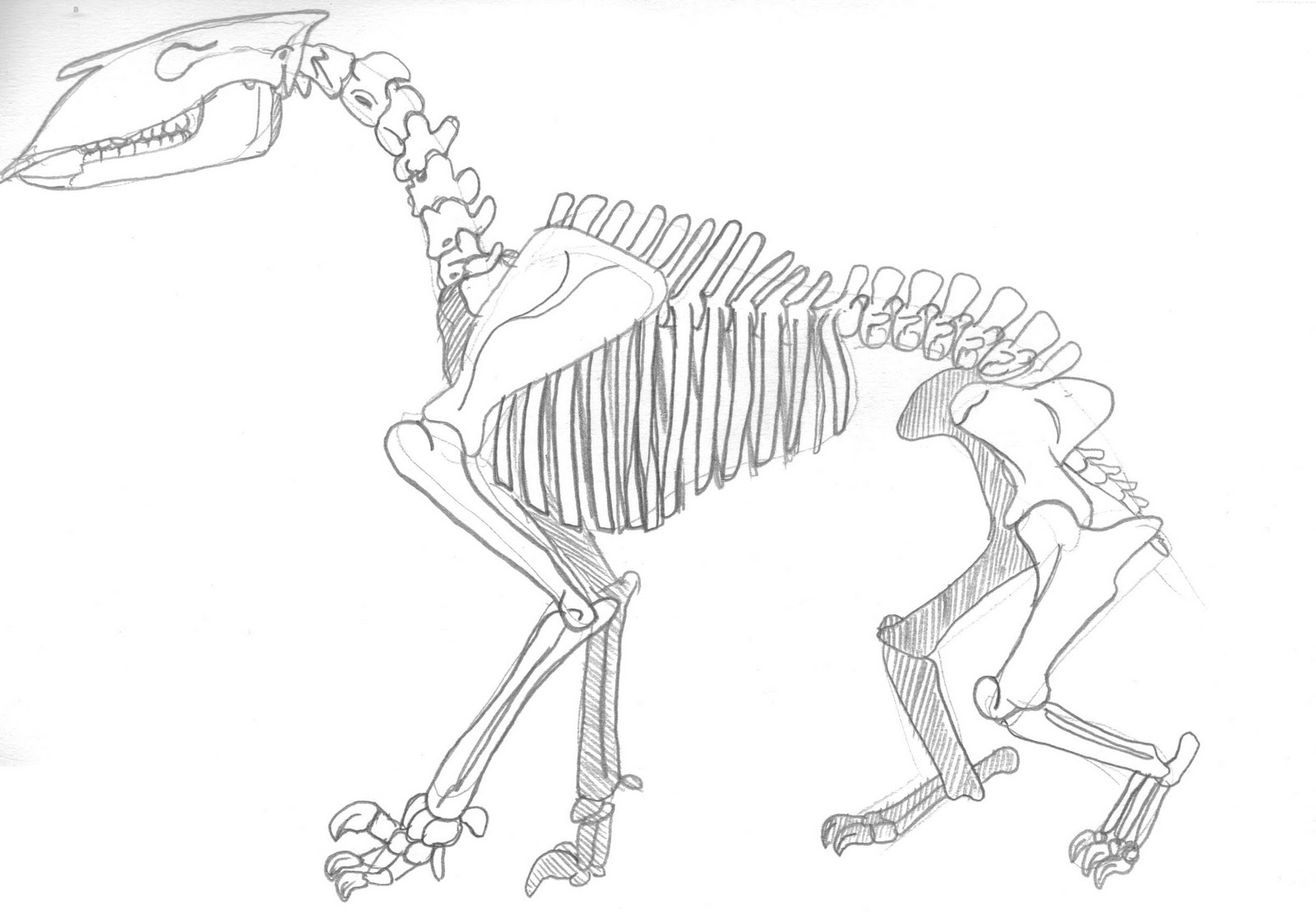
Moropus elatus Marsh, 1877
Chalicotheriidae; Perissodactyla; Mammalia; Chordata
Line drawing in graphite pencil
Drawn from mounted specimen at Natural History Museum, London, December 2010

Moropus isn't an elephant, or even a proboscidean, so it didn't end up in the ART Evolved gallery. This is the first place outside my sketchpad that this piece has been seen. Moropus was a chalicothere, a member of odd-shaped herbivorous mammals with relatively long forelimbs and short hindlimbs. They have well-developed claws on all limbs, and possibly used them to pull down leafy branches from up high to feed on. I didn't produce an acetate reconstruction of Moropus, but I might one day.


Paleoparadoxia tabatai Tokunaga, 1939
Paleoparadoxiidae; Desmostylia; Mammalia; Chordata
Line drawing in graphite pencil
Drawn from mounted specimen at Natural History Museum, London, December 2008

As you can see, I did this drawing over 2 years ago, whilst I worked at the library at the NHM. Paleoparadoxia is a member of the order Desmostylia, within the group of orders known as Afrotheria. The Afrotheria consist of six extant (surviving) orders: Proboscidea (elephants); Hyracoidea (hyraxes); Sirenia (manatees and dugongs); Tubulidentata (aardvarks); Afrosoricida (tenrecs and golden moles); and Macroscelidea (sengis, or elephant shrews). There are also a few completely extinct orders, one of which was the Desmostylia.

They mostly lived around the northern Pacific Ocean, with localities mostly in Japan, western Canada and the western United States. Several genera have been named, and although it is believed that all desmostylians were aquatic to some extent, some were more ocean-going than others. The main evidence for such a conclusion is bone density, which reveals just how heavy and able to sink or float the animals were.


Paleoparadoxia tabatai life reconstruction
Graphite pencil illustration
Drawn from mounted specimen (skeleton) at Natural History Museum, London, December 2010

Whilst at the Museum on the day I drew the rest of the specimens, I thought I'd do a life reconstruction of this desmostylian. I'm not very happy with the way the face has turned out, as I don't think I've drawn the teeth accurately at all. In my defence, the specimen on display is quite poor, and a lot of liberties have to be made as to tooth count and position of limbs.


Phiomia serridens Andrews & Beadnell, 1902
Phiomiidae; Proboscidea; Mammalia; Chordata
Graphite pencil illustration Drawn from specimen at Natural History Museum, London, December 2010

And this is the other new piece I submitted to the elephant gallery. Phiomia was a small, early proboscidean with a short trunk. A skull is on display next to a reconstructed model of it. My own reconstruction, therefore, was unnecessary. Also, I only had the skull to work from.

May I take this opportunity to remind you of the official Facebook group, and the first volume of The Disillusioned Taxonomist in print form, covering posts from mid to late 2008.