Thursday, 20 May 2010

Squamates Part I

The order Squamata ('scaly ones') contains the lizards and snakes. The group used to be split into Sauria (the lizards) and Serpentes (the snakes), but this is not a natural grouping - snakes are legless, hypercarnivorous lizards. Since this is such a huge group (approaching 6000 species), with many interesting members, I shall break up the squamates into several arbitrary groups. The first contains the Agamidae, Anguidae, Chamaeleonidae, Cordylidae, and Corytophanidae (all order Squamata; class Sauropsida; phylum Chordata).


Male plumed basilisk
Basiliscus plumifrons (Cope, 1876) - Corytophanidae
Whipsnade Wild Animal Park
April 2009

The lizard called the basilisk should not be confused with the beast of the same name famed in mythology, and another similar one from the world of Harry Potter. This creature is very much real, and can't kill its prey with a single stare. It does do one rather remarkable thing though: it can run on water on its hind limbs. I bet Nagini couldn't do that.


Giant plated lizard
Gerrhosaurus validus Smith, 1849 - family Cordylidae
Colchester Zoo
June 2009

Plated lizards and sungazers are chunky, well-armoured African lizards of the family Cordylidae. They are popular pets, but not so popular as bearded dragons (see below). There are six species in the genus Gerrhosaurus, and this species can grow up to 69 cm in length.


Panther chameleon
Furcifer pardalis Cuvier, 1829 - Chamaeleonidae
Manchester Museum
July 2008

Chameleons are a very well-known group of Old World lizards reknowned for many things: their eyes which can move independently of one another; their extremely long sticky tongue used to ensnare their invertebrate prey; and most famously, their ability to change colour. The panther chameleon is a large Madagascan species (the island has a huge diversity of chameleons, from the tiny leaf chameleons of the genus Brookesia to the Oustalets' chameleon - Furcifer oustaleti) with large spots on its body which change colour accordingly dependent on the animal's surroundings and mood.


European chameleon
Chamaeleo chamaeleon Linnaeus, 1758 - Chamaeleonidae
Wild in eastern Cyprus
October 2008

There are two species of chameleon in Europe: this one occurs in Greece and many of the Aegean islands, as well as Cyprus and elsewhere. The African chameleon, C. africanus, also occurs in Greece. We spotted this individual crossing the road in the vicinity of Famagusta on the eastern coast of North Cyprus. I found it retreating into the undergrowth and attempted to catch it but it put up a fight, hissing and rocking its body from side to side as only pissed off chameleons know how to do. I had to make do with a few fuzzy photographs, and this one which captures its mood perfectly I think.


Scheltopusik
Ophisaurus apodus Pallas, 1775 - Anguidae
London Zoo
December 2009

There are several families of legless lizards - many people in Britain and Europe are familiar with slow worms (Anguis fragilis), a legless lizard which is oft mistaken for a snake. The scheltopusik is a Eurasian species, also called the glass lizard. This name originates from the common behaviour strategy amongst many lizard groups to shed their tail when stressed - a phenomenon known as caudal autotomy. This is also the origin to the specific name of the slow worm - fragilis - something which many people realise when they pick up a lizard by the tail and are left with a wriggling tail and a look of shock on their face.
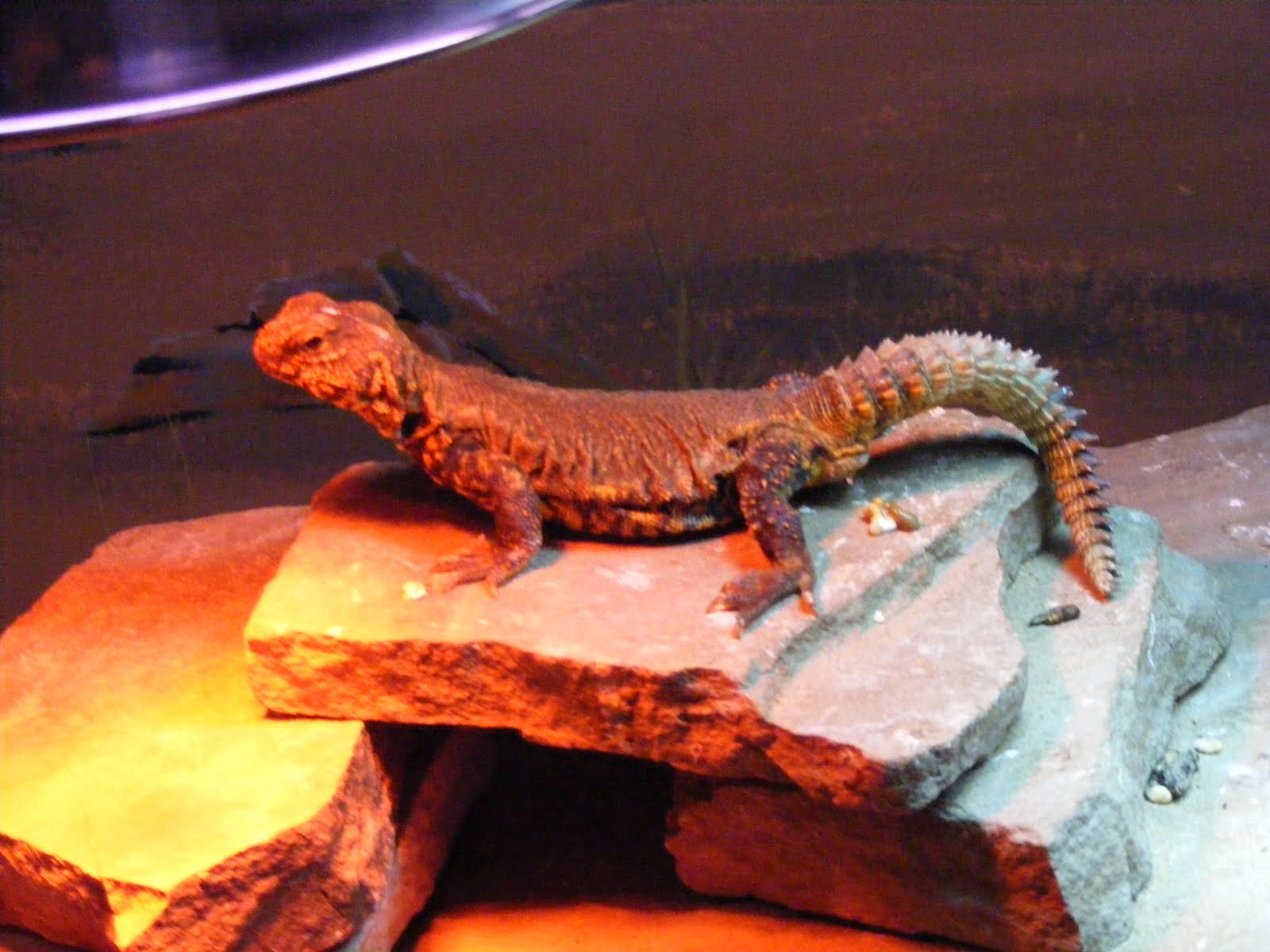


Saharan uromastyx
Uromastyx geyri Muller, 1922 - Agamidae
Shepreth Wildlife Park, Cambridgeshire
September 2008

Uromastyx lizards, also called dab lizards, mastigures, or spiny-tailed lizards, are desert-dwelling reptiles from north Africa and the Middle East with fattened spiny tails. These tails are used as a fat source and a defence against would-be predators.


Philippine sailfin lizard
Hydrosaurus pustulatus (Eschscholtz, 1829) - Agamidae
Colchester Zoo
June 2009

A large tree-dwelling agamid with two conspicuous sails on its back and tail, the Philippine sailfin lizard will escape predators by plunging into the water below the tree in which it will otherwise be resting. They are good swimmers and, like the basilisk, can run on water, but quadrupedally rather than bipedally.


Frilled lizards
Chlamydosaurus kingii Gray, 1827 - Agamidae
Crews Hill, North London
May 2009

One of the best known of the agamids, the frilled lizard or frilled dragon is familiar to most people for its threat display. The fold of skin which almost completely encircles its neck is erected, the mouth is opened, and the lizard runs on its hind legs towards its attacker. This is usually enough to deter its predators, which in the Australian outback would include dingos, monitor lizards, quolls, and birds of prey. The frill around the neck also features on the Dilophosaurus in the first Jurassic Park movie - there is no evidence for this, nor its ability to spit venom in the faces of dinosaur DNA thieves.


Agama
Laudakia stellio (Linnaeus, 1758) - Agamidae
Wild at Bellapais Abbey, North Cyprus
April 2009

The family Agamidae is distributed in the Old World, with many species found in Africa, Asia, and Australasia. It is represented only by Laudakia stellio in Europe, and only marginally at that. It is one of the most common reptiles in Cyprus, and large and small individuals abound wherever there is a sunny spot to bask. It is also the largest lizard present on the island.


Juvenile agama
Wild at Bellapais Abbey
October 2008

Young agamas are more brightly patterned than the adults, as the above individual shows. They commonly have a diamondback pattern and a banded tail.


Bearded dragon ("Mr. Gibbs")
Pogona sp. Storr, 1982 - Agamidae
Photographs courtesy of Jason Kay

The bearded dragon is probably everyone's favourite agamid... it certainly is a popular pet, and rightly so. It can be a charming, friendly, and inquisitive companion, isn't very demanding in its needs, and gets to a manageable size. Best of all, you can handle them - you can't do that to amphibians.

There are seven species in the genus Pogona, and most them do appear in the pet trade from time to time. Since they differ only in very small ways, it can be difficult to tell which species any given individual is. The majority probably belong to P. vitticeps (Ahl, 1926), the inland bearded dragon, which is the most common in the wild, although Lawson's dragons - P. henrylawsoni Wells & Wellington, 1985 - are popular too.

It has been observed that some species, including P. barbata, have vestigial venom glands from the ancestral squamate from which all lizards and snakes evolved. Not only is venom present in snakes, but also in two groups of lizards - the monitors and the beaded lizards - it could be found to be present in other lineages too. Of course, bearded dragons are completely safe to handle - the venom glands are not ducted and they do not have fangs.

More lizards to come...

Wednesday, 19 May 2010

Caudata

Yesterday we had the anurans (frogs and toads). Now its the turn of the newts and salamanders to take the spotlight. Order Caudata; Class Amphibia; Phylum Chordata


Alpine newt larva (about 2 days old)
Ichthyosaura alpestris (Laurenti, 1768) - Salamandridae
Hatched from eggs at home
June 2008

This species has gone through a couple of significant name changes in the last couple of years. For a long while it was lumped into the genus Triturus with all other European newts, but was placed into its own genus, Mesotriton, a couple of years ago. It turns out that the generic name Ichthyosaura was erected for this species some time before Mesotriton, so that name gets priority. Taxonomy is weird, I told you.


Male palmate newt (top) and male smooth newt
Lissotriton helveticus Razoumousky, 1789 / L. vulgaris (Linnaeus, 1758) - Salamandridae
Wild caught in Epping Forest, Essex
March 2009

The main difference between these two native British species can be seen clearly in this photograph. While smooth newts occasionally have enlarged feet during the breeding season, they are never black, unlike the male palmate newt.


Male great crested newt
Triturus cristatus (Laurenti, 1768) - Salamandridae
Wild in Epping Forest
March 2009

Don't try this at home. You need to have a licence or be in the company of someone with a licence to hold a great crested newt in the UK (I was the latter). Their alternate name of 'warty newt' is quite apt, as they are distinctly lumpy to the touch. They are the biggest of the British newts, and by far the most impressive.


Japanese fire-bellied newt
Cynops pyrrhogaster (Boie, 1826) - Salamandridae
London Zoo
December 2009

This species, and its close relative from mainland Asia, the Chinese fire-bellied newt (C. orientalis) are popular pets, although this species is larger and apparently more aggressive, and the two species should not be kept together.


Immature smooth newt
Lissotriton vulgaris
Wild in Epping Forest
March 2009

I dug up this little guy in the undergrowth, probably just rousing from its winter hibernation. Smooth newts are the most common of the newts in the southeast of England and in much of the UK and western Europe.


Himalayan crocodile newt
Tylototriton verrucosus Anderson, 1871 - Salamandridae
London Zoo
December 2009

A bit of an exaggeration to liken a salamander to a crocodile, but here's the crocodile newt. There are other members of the genus, distributed in parts of Asia, with bright orange markings.


Male smooth newt
Lissotriton vulgaris
Wild in Epping Forest
March 2009

The male smooth newt has an orange belly and jagged crest in the breeding season, but neither feature is as pronounced as in the great crested newt.


Male palmate newt
Lissotriton helveticus
Wild in Epping Forest
March 2009

The male palmate newt in the breeding season has the black hind feet and filamentous ending to the tail. The crest is lower than the smooth newt's and the belly is pinker and with less spots.


Female smooth newt
Lissotriton vulgaris
Wild in Epping Forest
March 2009

Female smooth newts have orange bellies with black spots - this individual has a pea mussel (Pisidium sp.) stuck to its right forelimb.


Female palmate newt
Lissotriton helveticus
Wild in Epping Forest
March 2009

Female palmates are hard to tell from smooths, even during the breeding season, but the throat is pink and with very few spots.


Male alpine newt
Ichthyosaura alpestris
At home in Enfield
June 2008

I tried keeping alpine newts for a brief spell a couple of summers ago. Alpine newts like cool water, and while creating a heated environment in a tank is easy, cooling an aquarium is not. The pair of newts weren't eating, despite having all the bloodworms they could ever want. I gave them back to the pet shop I acquired them from, and stuck to axolotls, xenopus frogs, and catfish.


Female alpine newt
Ichthyosaura alpestris
At home in Enfield
June 2008

I keep typing 'Ichthyostega' instead of 'Ichthyosaura'. That blue stuff on the female above is the tissue paper that the male is sitting on in the previous photo.


Giant salamander skeleton
Andrias scheuchzeri (Holl, 1831) - Cryptobranchidae
Natural History Museum, London
September 2009

Does this look like a human skeleton to you? No, me neither. But early palaeontologists believed the remains of a giant salamander - closely related to todays giant salamanders of China and Japan, and the hellbender (Cryptobranchus alleghaniensis) of North America - to be those of the humans who lived before the great flood of biblical times. It was given the scientific name Homo diluvii testis, translating as 'evidence of a diluvian human'. When it was realized that it is infact an amphibian, not a human, it was given the new generic name Andrias, meaning 'image of man'.


Wild type axolotl
Ambystoma mexicanum (Shaw, 1789) - Ambystomidae
Temporary aquarium at home
March 2007

I kept axolotls for a period of four years. At one point, I had three, living together in harmony in the same aquarium - Slash, my golden axolotl (photo below), George who was white with dark eyes and red gills, and Mildred, the wild type who appears above. Mildred began to take chunks out of the other two - George lost most of three of his limbs and much of his gills and died a few months later; Slash's wounds were mostly superficial and healed well. When it became known to me that Mildred was a man-eater, I isolated her, and decided to sell her. Poor thing, she was a beauty really.


Golden axolotl
Ambystoma mexicanum
Aquarium at home
January 2005

Slash was my first axolotl, and the last to leave. Axolotls, in case you didn't know, are an excellent example of neoteny. This is commonly known as Peter Pan syndrome, where adults of breeding age take on physical characteristics of juveniles. In the case of the axolotl, it is basically a giant tadpole. They have some characteristics of tadpoles, such as gills and a fin on the tail, and others of adult salamanders, such as partial lungs, and legs. They can be forced to metamorphose into adults through hormonal injections.

I think I'll do squamates (lizards and snakes) next. Stay tuned!

Tuesday, 18 May 2010

Anuran overload

Here's a selection of photos of frogs and toads (order Anura; class Amphibia; phylum Chordata) from my portfolio. Enjoy!


Pool frog
Pelophylax lessonae (Camerano, 1882) - Ranidae
Slimbridge Wetland Centre, Gloucestershire
September 2009

Once thought to be an invasive species in eastern England, the pool frog was exterminated, before realising it is in fact native, as there are subfossil remains. D'oh! It's back in the wild in the UK now.


Marsh frog
Pelophylax ridibundus (Pallas, 1771) - Ranidae
Crews Hill, Enfield, North London
June 2008

Hybridises with the pool frog to create the edible frog (Pelophylax kl. esculenta), so called because it is the type most often used to create the French delicacy, frog's legs. Or grenouille if you're French.


Levantine frog
Pelophylax bedriagae (Camerano, 1882) - Ranidae
Wild at Geçitköy Reservoir, North Cyprus
April 2009

Very similar to the marsh frog, which doesn't occur in southwestern Asia.


Female common frog
Rana temporaria Linnaeus, 1758 - Ranidae
Wild in Epping Forest, Essex
March 2009

The most common frog species in the wild in Britain and much of western Europe. This is a female in prime breeding condition, and on the lookout for mates.


Albino xenopus frog, or African clawed toad
Xenopus laevis Daudin, 1802 - Pipidae
Aquarium at home
September 2008

I had two albino xenopus frogs for a couple of years, named Elaine and Kitchener - here's one of them (sorry I can't tell from that angle!) with a mouthful of spaghetti... nope, they're chironomid larvae (bloodworms).


Tomato frogs
Dyscophus antongilii Grandidier, 1877 - Microhylidae
Manchester Museum
July 2008

Bright orange frogs from Madagascar.


Argentine horned frog
Ceratophrys ornata Bell, 1843 - Leptodactylidae
Natural History Museum, London
June 2009

This rather obese-looking individual was appropriately named 'Sumo', and was resident in the Natural History Museum's Darwin exhibit and followed by the butterfly exhibit last year. The horned frogs are popular pets, and are often known as Pacman frogs, for obvious reasons.


Giant leaf frog
Phyllomedusa bicolor (Boddaert, 1772) - Hylidae
Jardin des Plantes, Paris
January 2010

This large tree frog exudes a waxy substance which it spreads around its entire body using only its feet. Also called the waxy monkey frog.


Golden poison-dart frogs
Phyllobates terribilis (Myers, Daly, and Malkin, 1978) - Dendrobatidae
Jardin des Plantes, Paris
January 2010

Amongst the most dangerous of all animals. Its poison is reputed to kill from secondary contact through another medium. It is completely harmless in captivity, as it extracts the batrachotoxins from some sort of prey animal, which is as yet unknown. That insect would probably be the most toxic animal of all time.


Skeleton of South American common toad
Rhinella margaritifera (Laurenti, 1768) - Bufonidae
Galeries de Paléontologie et Anatomie comparée, Paris
January 2010

Look at those crests! Closely related to the much-maligned cane toad (R. marina), a native of South America introduced to Australia for pest control, and it has ironically become a pest in its own right.


Rococo toad
Chaunus schneideri Werner, 1894 - Bufonidae
London Zoo
December 2009

This really is one huge mother of a toad.


Panther toad
Amietophrynus pantherinus Smith, 1828 - Bufonidae
Crews Hill
June 2008

A southern African species which turns an amazing leopard-like pattern in the breeding season.


Male common toad
Bufo bufo (Linnaeus, 1758) - Bufonidae
Wild in Epping Forest
March 2009

Male common toads are smaller than females... this and the nuptial pads on the hands (for gripping onto the female during coitus) are the best way to tell apart the sexes. Unless you hold a male and give him a squeeze (Ooh! Matron!) ... if he makes a release call, he's basically telling you to back off and leave him to making babies.


Immature common toad
Wild in Enfield
August 2008

I found this toadlet (newly metamorphosized, but still very tiny, toad) in my garden and decided to keep it for a little while. I successfully fed it on aphids, but it ignored ants. I set it free after a couple of weeks because I was struggling to find any food for it.


Green toad
Pseudepidalea viridis (Laurenti, 1768) - Bufonidae
Crews Hill
June 2008

One of the more common toad species in continental Europe, but absent from Britain. Was formerly included in the genus Bufo, but that huge genus was split into several huge genera and a few smaller ones. The other British toad, the natterjack (Epidalea calamita), got its own genus.

I'll come round to the Caudata (newts and salamanders) next time.

Phoenicopteridae

Who doesn't know flamingos? The combination of long neck, long legs, and pink and red plumage make them amongst the most easily recognized of birds alive today. They make up the family Phoenicopteridae (from the Ancient Greek words for 'crimson wing'... although you could interpret the root word 'phoenix' - Φοῖνιξ - as the mythical bird of the same name), and most taxonomists place this family in its own order, the Phoenicopteriformes. Others include it in the same order as storks, herons, and ibises, the Ciconiiformes, but since that order sometimes includes falcons and other seemingly unrelated fowl, that's no surprise.

There are six (sometimes five... why is taxonomy so confusing?) species in three genera (sometimes one genus!). The genera all share the root 'Phoenico-', but have different suffixes. Modern day flamingos are distributed in southern Europe, much of Africa, southwestern and southern Asia, the West Indies, and Central and South America. South America boasts the most species, whilst only one is found in Europe.


Greater flamingo
Phoenicopterus roseus Pallas, 1811
Phoenicopteridae; Phoenicopteriformes; Aves; Chordata
Colour pencil drawing
May 2010

The greater flamingo is, as its name suggests, the largest of the six extant flamingos. It is distributed across southern Europe and Asia, as well as most of Africa. It is an inhabitant of coastal and interior wetlands, either permanent or temporary, taking advantage of concentrations of water during dry seasons to find their food. Like all flamingos, greater flamingos have a specialised bill with lamellae (flat plates) which act as a filter to separate small aquatic invertebrates and algae from the water, much as baleen whales do.


Greater flamingo
Slimbridge Wetland Centre, Gloucestershire
September 2009

The colour of wild flamingos varies, but there is usually some pink or red present in the plumage of all adults. Greater flamingos have the least red in their plumage, although their wing coverts are a stunning crimson, hence the generic name. The specific name, 'roseus', means 'pink', which describes the effect of red and white feathers in close proximity rather well.


Immature greater flamingo
Slimbridge Wetland Centre, Gloucestershire
September 2009

Young flamingos are born with a grey/brown plumage, not acquiring their distinctive coloration until adulthood. The parents of a flamingo chick will feed their young on a regurgitated fluid, similar in colour and texture to milk, which is produced in the crop (the forepart of the stomach used to hold food before regurgitation). This is not unique to flamingos amongst birds; pigeons are also known to produce 'milk', and who knows, perhaps some non-avian dinosaurs did too?


Caribbean flamingo
Phoenicopterus ruber Linnaeus, 1758
Phoenicopteridae; Phoenicopteriformes; Aves; Chordata
Colour pencil drawing
May 2010

The Caribbean, or American, flamingo, is a very colourful bird. It is not so much pink as hot pink - the specific name, 'ruber', is Latin for 'red'. It is often considered to belong to the same species as the greater flamingo, but this species does not occur in the Old World. It lives on the Galapagos Islands off the coast of Ecuador, many Caribbean islands and the Caribbean coast of Colombia and Venezuela. Its natural occurrence in Florida is debated: it is often considered an iconic bird of that state, although it probably only occurs there as escapees or vagrants from Cuba and other islands.


Caribbean flamingo
Jardin des Plantes, Paris
January 2010

Like the greater flamingo, Caribbean flamingos are pretty much restricted to coastal environments, with a preference for strongly saline waters where their preferred food, the brine shrimp (Artemia - most familiar to lay-people as the sea monkeys you can buy as dried eggs, or to fish-keepers as a common food for tropical fishes).


Chilean flamingo
Phoenicopterus chilensis Molina, 1782
Phoenicopteridae; Phoenicopteriformes; Aves; Chordata
Colour pencil drawing
May 2010

The third and final member of the genus Phoenicopterus is the most southerly distributed of them all. The Chilean flamingo occurs in temperate wetlands of southern South America, right to the tip of the continent. It is about the same size as the Caribbean flamingo, but much more muted in plumage colour. It is more pink, however, than the greater flamingo, and can be differentiated from its congeners by its grey legs with red 'knees'*, and bill, of which the terminal half is black.

* The part of the leg which appears to be the knee is in fact anatomically the ankle: the part which looks like the shin is the foot, while the 'foot' is really just toes. The thigh (femur) is obscured by the bird's feathers. Think of a chicken drumstick, which is the tibia and fibula, the part of the leg above the 'knee'. Sorry if I have completely confused you.


Chilean flamingos
Slimbridge Wetland Centre, Gloucestershire
September 2009

The preferred habitat of the Chilean flamingo is brackish lakes from sea level up to about 4500 m into the Andes Mountains. Chilean flamingos have become established in parts of Europe, as the climate of continental Europe most closely matches that of its native land than any of the other species.


Andean flamingo
Phoenicoparrus andinus Philippi, 1854
Phoenicopteridae; Phoenicopteriformes; Aves; Chordata
Colour pencil drawing
May 2010

The genus Phoenicoparrus ('crimson bird of ill omen') contains two species endemic to the mountains of South America. The larger of the two is the Andean flamingo, found in the alpine plateau known as the puna shared between Peru, Bolivia, Argentina, and Chile. Its pale yellow legs and bill distinguish it from the puna flamingo. The colour of the Andean flamingo's plumage is a rosy pink, which reminds me of raspberry milkshake.


Andean flamingo
Slimbridge Wetland Centre, Gloucestershire
September 2009

The two flamingo species of the genus Phoenicoparrus have narrower bills which are believed to aid in finding smaller food items than the other species. Food must be scarce in the alpine deserts of South America, and being able to filter out the smallest of nutrients from the brine must be advantageous to the Andean and puna flamingos.


Puna flamingo
Phoenicoparrus jamesi Sclater, 1886
Phoenicopteridae; Phoenicopteriformes; Aves; Chordata
Colour pencil drawing
May 2010

The puna, or James's, flamingo is the smallest of the South American flamingos, growing up to less than a metre tall (approximately three feet). It is restricted to the puna grassland of the high Andes, and are often found in mixed groups with the previous two species. In order for this to occur successfully in such a harsh habitat, they must be able to exploit different food sources. Being the smallest of the trio, the puna flamingo has the smallest bill, and thus is able to extract the smallest of diatoms (single-celled plants) from the brine.


Puna flamingo
Slimbridge Wetland Centre, Gloucestershire
September 2009

The puna flamingo has bright red legs and a black-tipped banana-yellow bill with a dark red face. It is amongst the most threatened of the flamingo species due to its remote location and small populations. It was once believed extinct, until a small breeding population was located in the 1950s. It is now considered 'near threatened' by the IUCN, but we all know that doesn't mean it's out of the woods yet.


Lesser flamingo
Phoeniconaias minor Geoffroy Saint-Hilaire, 1798
Phoenicopteridae; Phoenicopteriformes; Aves; Chordata
Colour pencil drawing
May 2010

The lesser flamingo is the sole member of the genus Phoeniconaias ('crimson nymph'), and is found in saline lagoons across east Africa and southern Asia. It is the smallest flamingo, standing at under a metre tall. Flocks of lesser flamingos are reputedly a shocking sight; they are amongst the most numerous of birds in the Rift Valley of Africa, concentrating where the water yields the most planktonic food.


Lesser flamingo amongst other species
Slimbridge Wetland Centre, Gloucestershire
September 2009

Lesser flamingos have somewhat more crimson plumage in the wild than most of the other species, but in captivity, due to a lack of carotenes (red, orange, and yellow pigments in foods which give the birds metabolise to create their own pigment) in their food, are a more muted pink. The eye is yellow, the bill is dark red and black, and the legs are crimson. Lesser flamingos are known to revel in the caustic lakes of the African Rift Valley, such as Lake Natron (so called because of its very high concentrations of sodium salts, including natron itself, which is a carbonate) - these waters support no other life except the prey items and the flamingos themselves. The brine is caustic enough to dissolve human flesh - with this in mind, the flamingo must be one of the most resilient of all birds.

Sunday, 2 May 2010

Invasive Species: Grey Squirrel


Eastern grey squirrel
Sciurus carolinensis Gmelin, 1788
Sciuridae; Rodentia; Mammalia; Chordata
Wild in London Zoo
December 2009

Britain’s native squirrel is the red squirrel (Sciurus vulgaris). It is now only “common” (very much reduced in number) in far flung corners of Great Britain, including the northern portion of Scotland, Cumbria, Merseyside, Anglesey in North Wales, and Norfolk, as well as the Isle of Wight. Elsewhere in the UK and Ireland, the grey squirrel reigns supreme. They are as ubiquitous as rats in urban parks, suburban gardens, and other types of open space.

The eastern grey squirrel was first introduced into the UK in 1876 to a park in Cheshire in the northwest of England. The first Irish grey squirrels appeared in 1911. The spread was rapid, as grey squirrels are less picky in their food sources and habitat requirements, pushing the red squirrels to areas the greys would rather not go.


Eastern grey squirrel
Wild in Oxford Botanic Gardens
July 2008

Grey squirrels are a pest species, and are classed as such. Just like the brown/Norway rat (Rattus norvegicus) and black/ship rat (R. rattus), it is perfectly legal to kill them. In fact, according to the Wildlife and Countryside Act 1981 (God, it’s a long time since I’ve quoted British environmental legislature...), it is illegal to release a trapped grey squirrel. I haven’t kept on top of this legislature, it may have changed in the last five years (it’s been that long since I did UK Nature Conservation at uni? Crikey.). Obviously, humane dispatch is encouraged, as it should be with other animals classed as vermin.

What damage do grey squirrels do anyway? Apart from their direct responsibility for the exile of the red squirrel to tiny pockets of suitable habitat, which are ruthlessly defended by conservationists to prevent grey squirrels from becoming established, they are direct competitors with birds for food at bird tables, and cause damage to saplings and other plants by biting.